






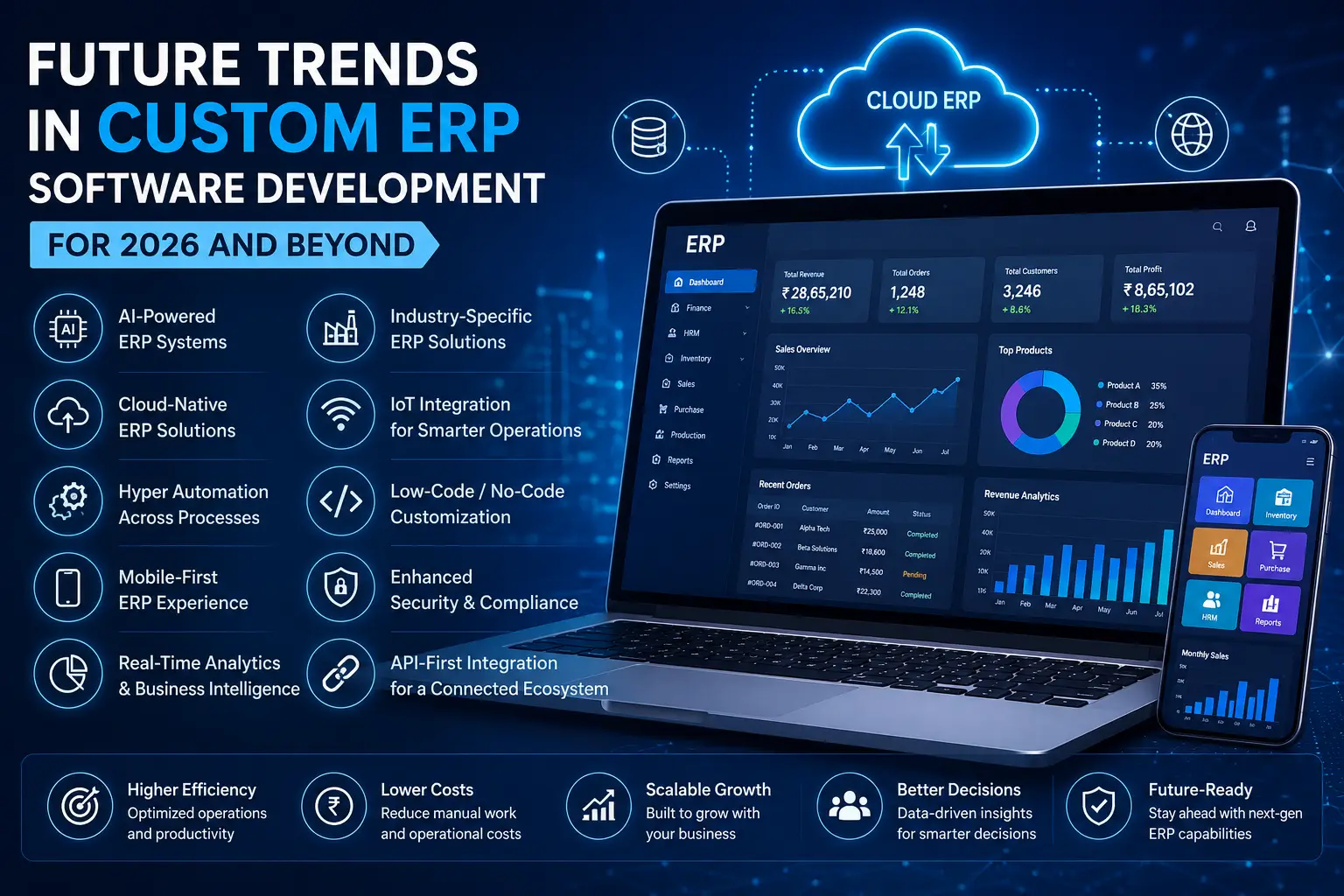
Top Future Trends in Custom ERP Software Development for 2026 and Beyond
Enterprise Resource Planning (ERP) software has become the backbone of modern businesses. As organizations embrace digital transformation, they need ERP systems that are intelligent, scalable, and tailored to their unique workflows. Traditional ERP platforms often lack the flexibility required to meet evolving business demands, which is why custom ERP software development is becoming the preferred choice.
In 2026 and beyond, technologies such as Artificial Intelligence (AI), cloud computing, automation, IoT, and predictive analytics are reshaping how ERP systems operate. Businesses are moving away from generic software toward custom-built ERP solutions that improve productivity, reduce costs, and support long-term growth. Industry analysts also point to AI-driven ERP, composable architecture, low-code customization, and cloud adoption as major trends shaping the next generation of enterprise software.
At Innoric Infosystems, we help organizations develop secure, scalable, and customized ERP software development that aligns perfectly with their business goals.
Why Businesses Are Choosing Custom ERP Software
Every business operates differently. A manufacturing company has different requirements than a hospital, school, retail business, or logistics company.
Custom ERP software offers:
- Business-specific workflows
- Easy integration with existing applications
- Better security
- Higher scalability
- Faster reporting
- Improved operational efficiency
- Lower long-term maintenance costs
Unlike off-the-shelf ERP solutions, custom ERP software evolves with your business.
Top Custom ERP Software Development Trends for 2026
1. AI-Powered ERP Systems
Artificial Intelligence is transforming ERP software from a data management tool into an intelligent business assistant.
Modern ERP systems can now:
- Predict customer demand
- Forecast inventory requirements
- Detect fraud
- Automate approvals
- Analyze business performance
- Recommend operational improvements
AI enables organizations to make faster, data-driven decisions while reducing manual effort. Major ERP vendors are rapidly expanding AI capabilities across finance, supply chain, HR, and customer operations.
2. Cloud-Native ERP Will Dominate
Cloud ERP adoption continues to grow because it provides flexibility, scalability, and remote accessibility.
Benefits include:
- Lower infrastructure costs
- Automatic software updates
- Better disaster recovery
- Improved collaboration
- Anywhere access
- High availability
Cloud ERP is becoming the standard choice for businesses of all sizes.
3. Hyper Automation Across Business Processes
Automation is replacing repetitive manual tasks throughout organizations.
Future ERP systems will automate:
- Invoice processing
- Payroll
- HR workflows
- Purchase approvals
- Inventory updates
- Customer notifications
- Compliance reporting
This increases productivity while reducing human errors.
4. Mobile-First ERP Experience
Business operations are no longer limited to office desktops.
Employees expect ERP access from smartphones and tablets for:
- Attendance
- Leave management
- Sales reporting
- Inventory tracking
- Purchase approvals
- Customer management
- Real-time notifications
Mobile ERP improves collaboration across remote and field teams.
5. Industry-Specific ERP Solutions
Instead of using generic software, businesses are investing in ERP systems designed specifically for their industry.
Examples include:
- Manufacturing ERP
- Hospital Management ERP
- School Management ERP
- Construction ERP
- Retail ERP
- Logistics ERP
- Real Estate ERP
Industry-specific ERP reduces implementation time while increasing productivity.
6. Real-Time Analytics and Business Intelligence
Modern ERP software delivers live dashboards instead of static reports.
Decision-makers can monitor:
- Revenue
- Expenses
- Inventory
- Production
- Sales
- Customer behavior
- Employee productivity
This enables faster and more informed business decisions.
7. IoT Integration
Internet of Things (IoT) devices are increasingly connected with ERP platforms.
Businesses can monitor:
- Machines
- Equipment
- Vehicle fleets
- Warehouse assets
- Manufacturing processes
Real-time IoT data improves maintenance planning and operational efficiency.
8. Low-Code and No-Code ERP Customization
Organizations increasingly want to modify ERP workflows without extensive coding.
Low-code platforms enable:
- Faster development
- Reduced implementation costs
- Easier workflow customization
- Rapid deployment
- Better business agility
Composable ERP and low-code tools are expected to remain key enterprise software trends.
9. Enhanced Cybersecurity and Compliance
ERP systems contain sensitive financial and operational information.
Future ERP platforms will include:
- Multi-factor authentication
- Role-based access
- Data encryption
- Security monitoring
- Audit logs
- Compliance management
Security will remain a top priority as businesses handle increasing volumes of digital data.
10. API-First Integration
Businesses use multiple software applications every day.
Modern ERP systems integrate seamlessly with:
- CRM software
- HRMS
- Accounting software
- Payment gateways
- E-commerce platforms
- BI tools
- Third-party applications
API-first architecture creates a unified digital ecosystem with real-time data synchronization.
11. Sustainable and Green ERP
Organizations are focusing on environmental responsibility.
Future ERP solutions will help businesses:
- Track energy consumption
- Monitor carbon emissions
- Reduce operational waste
- Optimize resource usage
- Support ESG reporting
Sustainability reporting is becoming an increasingly important ERP capability.
Industries That Benefit Most from Custom ERP
Custom ERP software is ideal for:
- Manufacturing
- Healthcare
- Educational Institutions
- Logistics & Transportation
- Retail & E-commerce
- Construction
- Hospitality
- Pharmaceuticals
- Distribution
- Financial Services
Why Choose Innoric Infosystems for Custom ERP Development?
Innoric Infosystems develops scalable ERP solutions that align with your business processes.
Our ERP Development Services
- Custom ERP Development
- Cloud ERP Solutions
- ERP Modernization
- ERP Integration
- Mobile ERP Applications
- ERP Maintenance & Support
- AI-Powered ERP Solutions
- Business Intelligence Dashboards
Why Businesses Trust Us
- Experienced ERP developers
- Industry-specific expertise
- Secure architecture
- Scalable solutions
- User-friendly interface
- Ongoing support
- Cost-effective implementation
Final Thoughts
The future of ERP software is intelligent, connected, and highly customizable. AI, cloud computing, automation, IoT, real-time analytics, and low-code development are transforming ERP systems into strategic business platforms rather than simple management tools.
Organizations that invest in custom ERP software today will be better prepared for tomorrow’s challenges, with greater efficiency, stronger security, and improved decision-making.
If you’re planning to build or upgrade an ERP solution, Innoric Infosystems can help you design a future-ready platform tailored to your business requirements.
Frequently Asked Questions (FAQs)
1. What is custom ERP software?
Custom ERP software is a business management solution designed specifically for an organization’s workflows, departments, and operational requirements.
2. Why should businesses choose custom ERP over off-the-shelf software?
Custom ERP provides greater flexibility, scalability, seamless integrations, improved security, and business-specific features that generic ERP systems often cannot deliver.
3. What technologies are shaping ERP development in 2026?
Key technologies include Artificial Intelligence (AI), cloud computing, automation, IoT, Business Intelligence (BI), predictive analytics, low-code development, and API-first architecture.
4. Which industries benefit most from ERP software?
Manufacturing, healthcare, education, retail, logistics, construction, hospitality, finance, and e-commerce are among the industries that benefit the most.
5. Does Innoric Infosystems develop F?
Yes. Innoric Infosystems develops secure, scalable, cloud-enabled, and fully customized ERP solutions for businesses across multiple industries.