






Hospital Information System (HIS): Complete Guide, Cost, Benefits & Why It Matters in 2026
Introduction
Healthcare is rapidly becoming more digital. Hospitals, clinics, diagnostic centers, and multi-specialty healthcare organizations now rely on technology to improve patient care, streamline operations, and reduce administrative burdens. One of the most important technologies driving this transformation is the Hospital Information System (HIS).
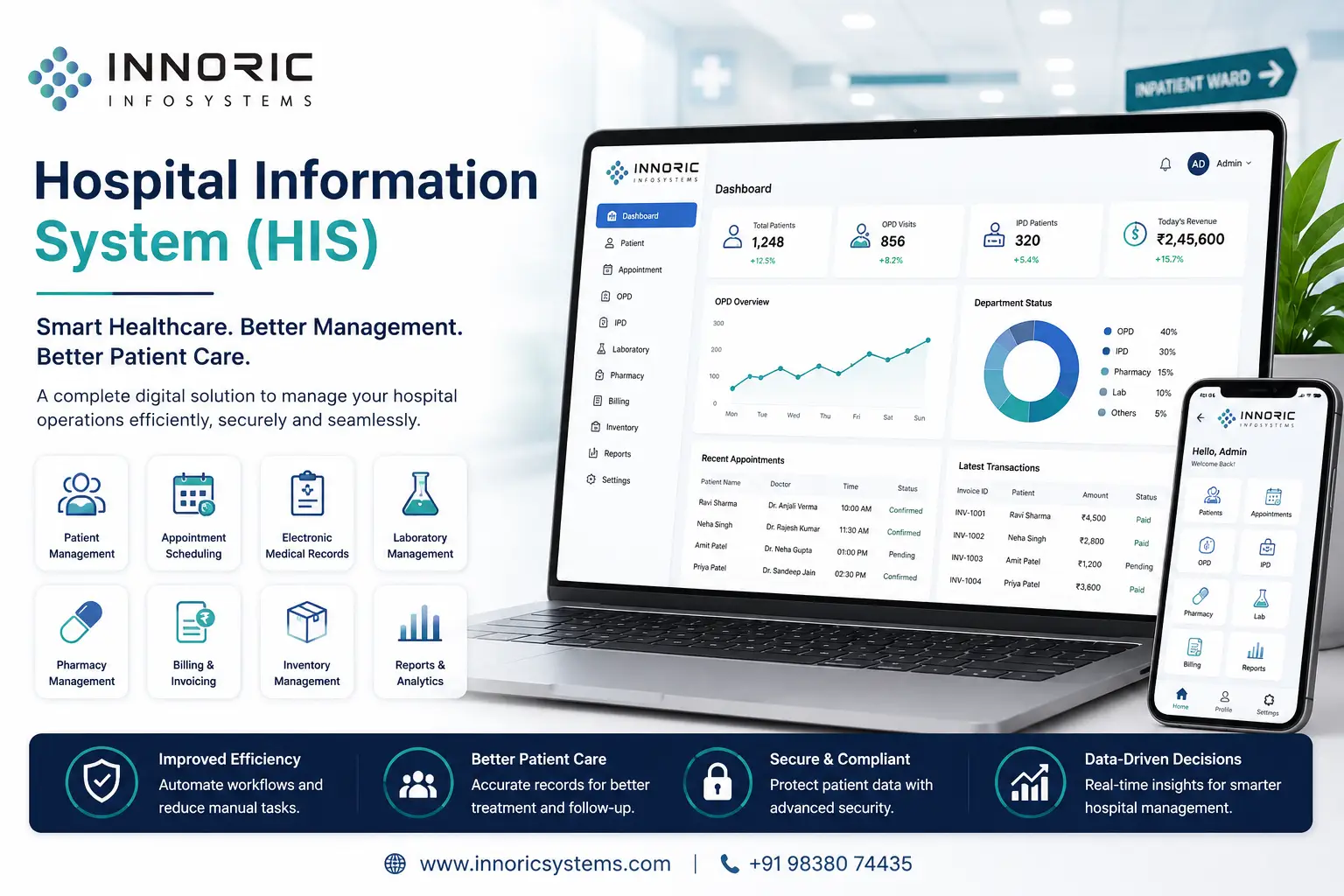
A Hospital Information System integrates clinical, administrative, financial, and operational processes into a single platform. From patient registration and appointment scheduling to billing, pharmacy, laboratory, inventory, and medical records, an HIS enables healthcare providers to manage their entire workflow efficiently.
At Innoric Infosystems, we develop secure, scalable, and customizable Hospital Information Systems that help healthcare organizations improve patient experiences while increasing operational efficiency.
What is a Hospital Information System (HIS)?
A Hospital Information System (HIS) is a comprehensive software solution that manages the day-to-day operations of hospitals and healthcare facilities. It connects different departments into one centralized system, ensuring that patient information is accurate, secure, and easily accessible.
Instead of maintaining separate records for registration, billing, laboratory reports, pharmacy, and patient history, an HIS integrates all these functions into a single digital platform.
Why is a Hospital Information System Important?
Healthcare organizations handle thousands of patient records, appointments, prescriptions, and financial transactions every day. Manual processes can lead to delays, duplicate records, billing errors, and communication gaps.
An HIS helps by:
- Improving patient care through accurate and accessible records.
- Reducing paperwork and manual data entry.
- Enhancing communication between departments.
- Speeding up appointments, admissions, and discharge processes.
- Providing real-time reporting for better decision-making.
- Supporting compliance with healthcare regulations.
- Improving resource utilization and reducing operational costs.
Key Modules of a Hospital Information System
1. Patient Registration & Management
- New patient registration
- Unique patient ID generation
- Demographic details
- Medical history
- Insurance information
- Digital patient records
2. Appointment Management
- Online appointment booking
- Doctor scheduling
- Appointment reminders
- Queue management
- Follow-up appointments
3. Electronic Medical Records (EMR)
- Digital patient history
- Clinical notes
- Diagnoses
- Treatment plans
- Prescription records
- Vaccination history
4. Outpatient (OPD) Management
- OPD registration
- Consultation records
- Prescription generation
- Doctor notes
- Billing integration
5. Inpatient (IPD) Management
- Admission process
- Bed allocation
- Ward management
- Nursing records
- Discharge summaries
6. Laboratory Management
- Test requests
- Sample tracking
- Result generation
- Report sharing
- Integration with patient records
7. Pharmacy Management
- Medicine inventory
- Prescription processing
- Stock alerts
- Batch and expiry tracking
- Supplier management
8. Billing & Finance
- Patient billing
- Insurance claims
- GST-compliant invoices
- Payment tracking
- Revenue reports
- Financial analytics
9. Inventory & Asset Management
- Medical equipment tracking
- Consumables management
- Purchase orders
- Vendor management
- Stock monitoring
10. HR & Payroll
- Employee records
- Attendance
- Shift scheduling
- Payroll processing
- Leave management
11. Reports & Analytics
- Patient statistics
- Revenue analysis
- Department performance
- Inventory reports
- Operational dashboards
Benefits of a Hospital Information System
Better Patient Care
Doctors and medical staff can instantly access complete patient histories, laboratory results, prescriptions, and treatment records, leading to faster and more informed clinical decisions.
Improved Operational Efficiency
Automation reduces paperwork, minimizes duplicate entries, and accelerates routine administrative tasks.
Faster Billing
Integrated billing and insurance modules simplify payment processing and reduce billing errors.
Reduced Medical Errors
Digital records help minimize prescription mistakes, duplicate tests, and incomplete patient information.
Enhanced Data Security
Role-based access, encrypted databases, audit logs, and secure backups help protect sensitive patient information.
Better Inventory Management
Hospitals can track medicines, medical supplies, and equipment in real time, reducing shortages and wastage.
Data-Driven Decisions
Real-time dashboards and analytics provide management with insights into patient flow, revenue, occupancy, and operational performance.
Scalability
Modern HIS platforms can support single clinics, multi-specialty hospitals, diagnostic centers, and healthcare chains as they grow.
Features of a Modern Hospital Information System
- Cloud-based deployment
- Mobile access for doctors and staff
- Patient portal
- Telemedicine integration
- Online appointment booking
- SMS and email notifications
- E-prescriptions
- Digital document management
- Barcode and QR code support
- Role-based user access
- Audit trails
- Backup and disaster recovery
- API integration with third-party systems
Hospital Information System Cost in India
The cost of an HIS depends on the size of the hospital, the required modules, customization, deployment model, and integration needs.
| Hospital Type | Estimated Cost (INR) |
|---|---|
| Small Clinic (1–5 doctors) | ₹1,50,000 – ₹4,00,000 |
| Multi-Specialty Clinic | ₹4,00,000 – ₹10,00,000 |
| Medium Hospital (50–100 beds) | ₹8,00,000 – ₹20,00,000 |
| Large Hospital (100+ beds) | ₹20,00,000 – ₹75,00,000+ |
| Enterprise Hospital Chain | Custom Pricing |
Factors Affecting Cost
- Number of users
- Number of hospital branches
- Required modules
- Cloud or on-premise deployment
- Third-party integrations
- Mobile applications
- Data migration
- Ongoing maintenance and support
While the initial investment varies, a well-designed HIS often reduces operational costs over time through improved efficiency and fewer manual errors.
Cloud-Based vs On-Premise HIS
| Cloud HIS | On-Premise HIS |
| Lower upfront investment | Higher initial hardware cost |
| Accessible from anywhere | Access mainly within the hospital network |
| Automatic updates | Manual software updates |
| Easy scalability | Hardware upgrades required for scaling |
| Vendor-managed backups | Hospital-managed backups |
Why Choose a Custom Hospital Information System?
Every healthcare organization has unique workflows. A custom HIS offers:
- Tailored modules and workflows
- Seamless integration with existing systems
- Better user experience
- Scalability for future growth
- Compliance with local requirements
- Advanced reporting and analytics
- Greater flexibility than off-the-shelf software
Why Choose Innoric Infosystems?
Innoric Infosystems develops customized Hospital Information Systems for hospitals, clinics, nursing homes, and diagnostic centers.
Our Healthcare Software Services
- Hospital Information System (HIS)
- Clinic Management Software
- Electronic Medical Records (EMR)
- Laboratory Information System (LIS)
- Pharmacy Management System
- Billing & Insurance Management
- Appointment Scheduling
- Telemedicine Solutions
- Mobile Healthcare Applications
- Cloud Migration & Integration
- Maintenance & Technical Support
Why Healthcare Providers Choose Us
- Customized solutions
- Secure architecture
- User-friendly interface
- Scalable cloud deployment
- Affordable implementation
- Dedicated support
- Integration with third-party healthcare platforms
Conclusion
A Hospital Information System is no longer a luxury—it is an essential tool for delivering efficient, high-quality healthcare. By integrating clinical, administrative, financial, and operational processes into one platform, HIS helps hospitals reduce costs, improve patient satisfaction, and make informed decisions.
Whether you operate a small clinic or a large multi-specialty hospital, investing in a customized HIS can improve efficiency, enhance patient care, and prepare your organization for future growth.
With Innoric Infosystems, you gain a trusted technology partner capable of building secure, scalable, and feature-rich Hospital Information Systems tailored to your healthcare needs.
Frequently Asked Questions (FAQs)
1. What is a Hospital Information System (HIS)?
A Hospital Information System is software that manages hospital operations, including patient records, appointments, billing, pharmacy, laboratory, inventory, HR, and reporting from a single platform.
2. What is the difference between HIS and EMR?
HIS is a complete hospital management solution covering administrative and clinical operations, while EMR (Electronic Medical Records) primarily focuses on a patient’s digital medical records.
3. How much does a Hospital Information System cost?
Costs vary based on hospital size and customization. Small clinics may spend around ₹1.5–4 lakh, while larger hospitals often require customized enterprise solutions costing significantly more.
4. Is cloud-based HIS secure?
Yes. Modern cloud HIS platforms use encryption, role-based access, secure backups, and monitoring to help protect sensitive healthcare data.
5. Can Innoric Infosystems develop a customized Hospital Information System?
Yes. Innoric Infosystems designs and develops custom HIS solutions with modules for patient management, billing, pharmacy, laboratory, inventory, HR, analytics, and more, tailored to the specific needs of healthcare organizations.
6. What is a Hospital Information System?
A Hospital Information System (HIS) is a software platform that helps hospitals and clinics manage patient records, appointments, billing, pharmacy, laboratory, inventory, and other daily operations from a single centralized system. It improves efficiency, reduces paperwork, and enhances patient care.
7. What is the difference between a Hospital Information System (HIS) and Hospital Management Software (HMS)?
Hospital Information System (HIS) and Hospital Management Software (HMS) are often used interchangeably. HIS typically refers to a broader solution that includes clinical, administrative, and financial management, while HMS focuses primarily on hospital operations. Modern solutions usually combine both into one integrated platform.