






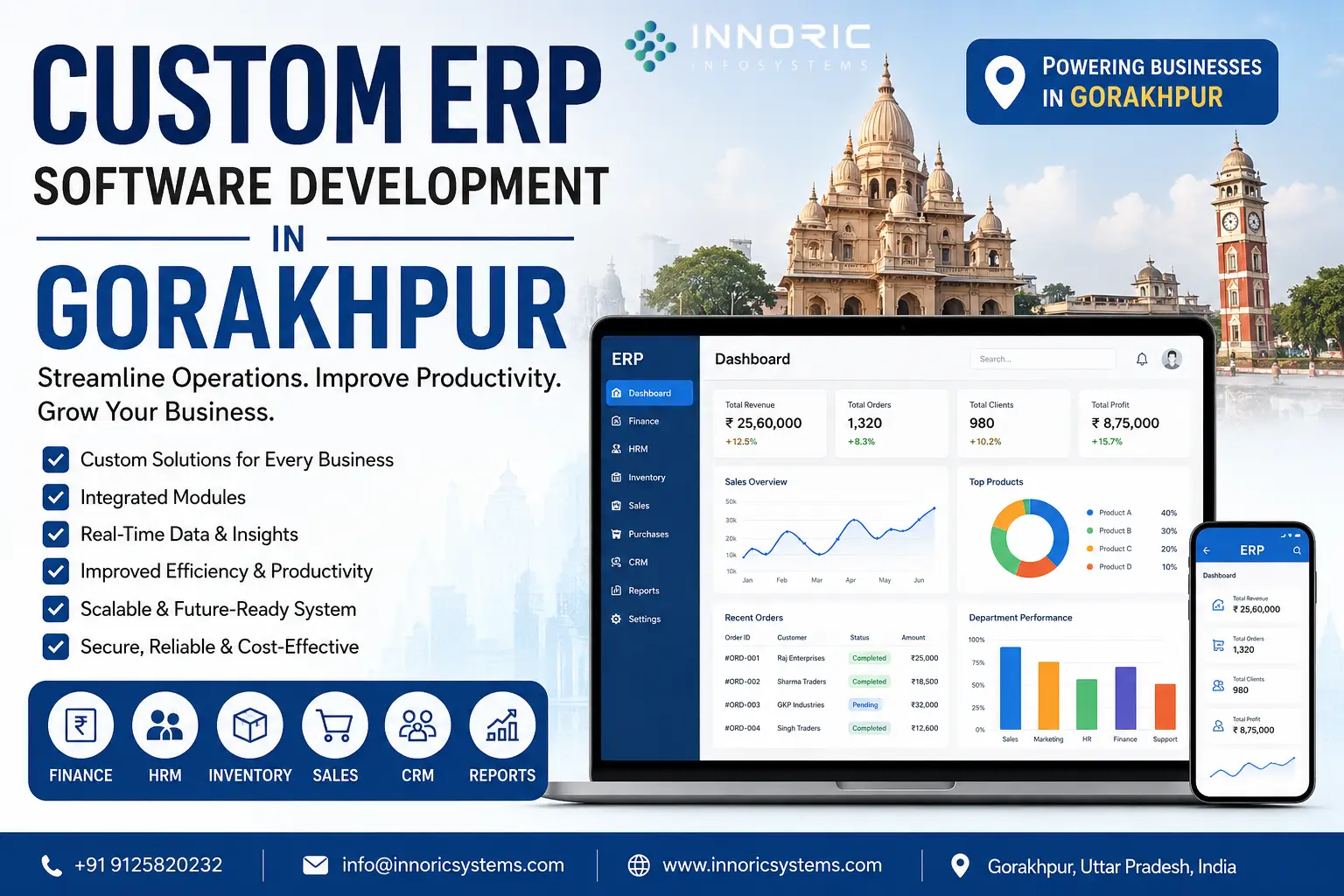
Custom ERP Software Development in Gorakhpur: The Complete Guide for Growing Businesses in 2026
Businesses in Gorakhpur are rapidly embracing digital transformation to improve efficiency, reduce operational costs, and gain a competitive advantage. As companies grow, managing operations through spreadsheets and disconnected software becomes increasingly difficult. This is where Custom ERP Software Development becomes a game-changing solution.
A custom Enterprise Resource Planning (ERP) system integrates finance, inventory, sales, human resources, customer management, procurement, and reporting into a single platform tailored specifically to your business processes.
Whether you run a manufacturing unit, educational institution, healthcare facility, retail business, logistics company, or service-based organization in Gorakhpur, a custom ERP solution can streamline operations and accelerate growth.
What is Custom ERP Software?
Custom ERP software is a business management system designed and developed according to an organization’s unique requirements.
Unlike ready-made ERP solutions that offer generic features, custom ERP software is built specifically for your workflows, departments, reporting structures, and operational goals.
Custom ERP Includes:
- Finance & Accounting
- Inventory Management
- CRM
- Sales & Marketing
- Purchase Management
- HR & Payroll
- Manufacturing Management
- Project Management
- Customer Support
- Business Intelligence
The result is a centralized system that improves visibility, productivity, and decision-making.
Why Businesses in Gorakhpur Need Custom ERP Solutions
The business ecosystem in Gorakhpur is evolving rapidly. Organizations are facing challenges such as:
- Manual data entry
- Poor departmental coordination
- Inventory inaccuracies
- Delayed reporting
- Customer management issues
- Lack of real-time insights
Custom ERP software eliminates these challenges by automating workflows and centralizing information.
Common Industries Using ERP in Gorakhpur
- Manufacturing
- Educational Institutions
- Hospitals & Clinics
- Retail Businesses
- Distributors & Wholesalers
- Logistics Companies
- Construction Firms
- Service Providers
- E-commerce Businesses
Benefits of Custom ERP Software Development
1. Tailored to Your Business
Every organization operates differently.
Custom ERP software is designed around your business processes rather than forcing you to adapt to pre-built software limitations.
Benefits
- Personalized workflows
- Custom dashboards
- Department-specific modules
- Flexible reporting
2. Improved Operational Efficiency
ERP automates repetitive tasks and reduces manual effort.
Automation Examples
- Invoice generation
- Attendance tracking
- Inventory updates
- Purchase approvals
- Payroll processing
This saves time and minimizes human errors.
3. Real-Time Data Access
Decision-makers can access live business information from a centralized dashboard.
View Real-Time Metrics
- Sales performance
- Stock levels
- Employee productivity
- Revenue trends
- Outstanding payments
Better visibility leads to better business decisions.
4. Increased Productivity
Employees spend less time managing spreadsheets and more time focusing on business growth.
ERP creates seamless communication between departments.
5. Better Customer Management
Integrated CRM modules help businesses:
- Manage leads
- Track customer interactions
- Improve service quality
- Increase customer retention
A better customer experience translates into higher revenue.
6. Scalability for Future Growth
As your business grows, your ERP can evolve.
New modules can be added without replacing the entire system.
Examples include:
- Mobile Apps
- AI Reporting
- Vendor Portals
- E-commerce Integration
- Advanced Analytics
Essential Modules in a Custom ERP System
Finance & Accounting Module
Manage:
- Accounts Payable
- Accounts Receivable
- GST Reports
- Financial Statements
- Cash Flow
Key Benefits
- Accurate financial reporting
- Faster audits
- Better compliance
Inventory Management Module
Track inventory in real-time.
Features
- Stock Tracking
- Barcode Management
- Warehouse Control
- Reorder Alerts
Benefits include reduced stock-outs and optimized inventory levels.
Sales Management Module
Monitor the entire sales cycle.
Functions
- Lead Management
- Quotation Creation
- Order Processing
- Sales Analytics
Human Resource Management
Manage employees efficiently.
Features
- Attendance Tracking
- Leave Management
- Payroll Processing
- Employee Performance Reviews
Customer Relationship Management (CRM)
Strengthen customer engagement.
Capabilities
- Lead Tracking
- Follow-Up Management
- Customer History
- Support Ticketing
Procurement Management
Automate purchasing processes.
Includes
- Vendor Management
- Purchase Orders
- Approval Workflows
- Procurement Analytics
Manufacturing Management
Ideal for factories and production units.
Features
- Production Planning
- Bill of Materials
- Quality Control
- Production Tracking
AI-Powered ERP Trends in 2026
Artificial Intelligence is transforming ERP software.
Modern ERP systems now include intelligent features that improve efficiency and forecasting.
AI-Powered Features
Predictive Analytics
Forecast:
- Sales
- Inventory Demand
- Revenue Trends
Smart Reporting
Generate reports automatically using AI.
Intelligent Inventory Management
Predict stock requirements before shortages occur.
AI Chatbots
Provide instant employee and customer support.
Automated Workflow Recommendations
AI identifies bottlenecks and suggests process improvements.
Cloud ERP vs Traditional ERP
Cloud ERP
Advantages:
- Lower upfront costs
- Remote accessibility
- Automatic updates
- High scalability
Best for growing businesses.
On-Premise ERP
Advantages:
- Complete control
- Internal hosting
- Custom security configurations
Best for businesses with strict compliance requirements.
ERP Development Process
Step 1: Business Analysis
Understand:
- Current processes
- Pain points
- Future goals
Step 2: Requirement Gathering
Document:
- Modules needed
- User roles
- Reporting requirements
Step 3: ERP Design
Create:
- Wireframes
- Dashboards
- Workflow diagrams
Step 4: Development
Build modules and integrations according to business needs.
Step 5: Testing
Perform:
- Functional Testing
- Security Testing
- Performance Testing
- User Acceptance Testing
Step 6: Deployment
Launch the ERP system and migrate existing data.
Step 7: Training & Support
Train users and provide ongoing technical support.
How Much Does Custom ERP Development Cost in Gorakhpur?
ERP development costs vary based on complexity.
Small Business ERP
₹1,50,000 – ₹5,00,000
Medium Enterprise ERP
₹5,00,000 – ₹15,00,000
Advanced Enterprise ERP
₹15,00,000 – ₹50,00,000+
Factors affecting cost:
- Number of modules
- User count
- Integrations
- Mobile applications
- AI capabilities
Why Choose a Local ERP Development Company in Gorakhpur?
Working with a local ERP partner offers several advantages.
Benefits
- Better understanding of local business needs
- Faster communication
- On-site support availability
- Lower implementation costs
- Personalized consultation
- Easier training and deployment
Future of ERP Software
The future of ERP will be driven by:
- Artificial Intelligence
- Machine Learning
- Cloud Computing
- Predictive Analytics
- IoT Integration
- Mobile ERP Applications
Businesses adopting modern ERP solutions today will gain a significant competitive advantage tomorrow.
Conclusion
Custom ERP software has become an essential investment for businesses looking to improve productivity, streamline operations, and scale efficiently. Unlike generic software, a custom ERP solution adapts to your business processes, providing complete visibility and control over every department.
For businesses in Gorakhpur, investing in a custom ERP system can lead to faster growth, improved decision-making, enhanced customer satisfaction, and long-term operational success.
FAQs
What is Custom ERP Software?
Custom ERP software is a tailored business management solution designed specifically for an organization’s unique processes and requirements.
How long does ERP development take?
Most ERP projects take between 3 to 12 months depending on complexity.
Is ERP suitable for small businesses?
Yes. Modern ERP systems are scalable and can be customized for small, medium, and large businesses.
Can ERP integrate with existing software?
Yes. ERP systems can integrate with CRM, accounting software, e-commerce platforms, and third-party applications.
Does ERP improve productivity?
Absolutely. ERP automates manual tasks, reduces errors, and improves workflow efficiency across departments.