






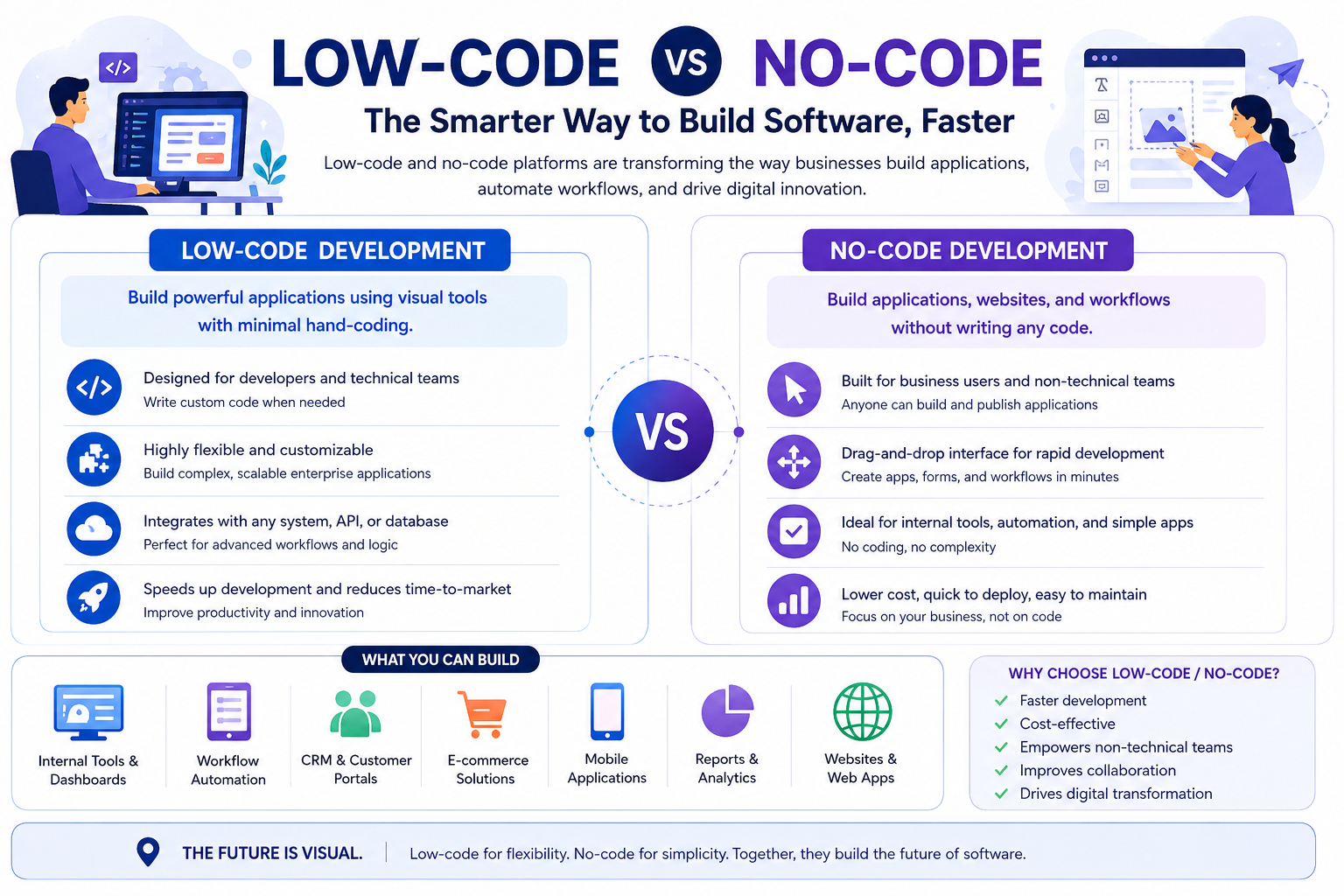
Low-Code vs No-Code Development: The Future of Smart Software Solutions for Businesses in Gorakhpur
In today’s digital economy, software drives almost every business operation. From customer management and sales tracking to workflow automation and mobile applications, companies depend heavily on technology to stay competitive. However, traditional software development often demands skilled programmers, large budgets, and lengthy timelines.
This challenge has created a major opportunity for low-code and no-code development platforms.
At Innoric Infosystems, Gorakhpur, we help businesses understand and adopt modern development technologies that make software creation faster, simpler, and more affordable.
Whether you’re a startup founder, enterprise owner, IT manager, or business professional, this guide explains everything you need to know about low-code and no-code development.
What Are Low-Code and No-Code Platforms?
Low-code and no-code are modern software development approaches that reduce or eliminate the need for traditional coding.
Instead of manually writing thousands of lines of code, users build applications through visual tools, drag-and-drop interfaces, workflow builders, and pre-configured components.
These platforms are changing how businesses create digital solutions.
Low-Code Development Explained
Low-code development provides a visual software development environment that reduces manual programming.
Users can build applications using:
- Drag-and-drop components
- Prebuilt templates
- Workflow automation tools
- Visual UI builders
- Database connectors
Professional developers can still add custom code whenever advanced logic, integrations, or specialized functionality is required.
Low-code acts as a bridge between traditional software development and rapid application creation.
What Is No-Code Development?
No-code platforms take simplification even further.
These platforms allow users to build applications without writing any code at all.
Everything is managed through a graphical interface.
No-code solutions are ideal for:
- Business owners
- HR managers
- Marketing teams
- Project managers
- Operations professionals
- Startup founders
Think of no-code development like assembling digital building blocks rather than programming software from scratch.
Why Businesses Are Adopting Low-Code and No-Code Development
Organizations across India and globally are rapidly investing in visual development technologies.
The reason is simple: speed, efficiency, and lower development costs.
Faster Software Development
Traditional software projects can take several months or even years.
Low-code and no-code platforms dramatically shorten this timeline.
Businesses can:
- Build applications faster
- Launch products quickly
- Test ideas rapidly
- Adapt to market changes efficiently
For startups in Gorakhpur, faster development often means reaching customers before competitors.
At Innoric Infosystems, we help businesses accelerate digital transformation using agile development approaches.
Reduced Development Costs
Hiring large software development teams can be expensive.
Visual development platforms help companies reduce expenses by minimizing heavy coding requirements.
Benefits include:
- Lower development budgets
- Reduced maintenance effort
- Faster deployment cycles
- Better resource utilization
This makes software innovation accessible even for small and medium-sized businesses.
Improved Team Productivity
Low-code tools automate repetitive development tasks.
As a result, technical teams spend less time on routine coding and more time on:
- Architecture planning
- Security optimization
- Advanced integrations
- Innovation initiatives
Business teams also gain greater independence by creating their own workflows and operational tools.
The Rise of Citizen Developers
One of the biggest transformations in modern software development is the emergence of citizen developers.
A citizen developer is a non-technical user who creates applications using low-code or no-code platforms.
These users may include:
- Finance professionals
- Operations managers
- HR executives
- Business analysts
- Entrepreneurs
Instead of waiting months for IT support, departments can develop internal tools themselves.
This empowers organizations to solve operational problems faster.
Collaboration Between Business and IT Teams
Low-code development encourages stronger collaboration.
Business users can visually design workflows while technical teams manage:
- Security standards
- Integrations
- Compliance requirements
- Infrastructure control
This partnership creates more efficient and practical digital solutions.
How Low-Code and No-Code Platforms Work
Many businesses ask:
“How can software be built without extensive coding?”
The answer lies in visual development architecture.
Visual Programming
Rather than typing code manually, users interact with graphical tools.
They create applications by:
- Designing interfaces visually
- Connecting workflows
- Configuring databases
- Setting automation rules
This method significantly reduces development complexity.
Automatic Code Generation
Behind the scenes, the platform automatically generates the required source code.
Users interact with visual models, while the platform handles:
- Syntax creation
- Backend logic
- Standardized development structures
- Deployment preparation
This eliminates much of the repetitive programming workload.
Cloud-Based Development Platforms
Most modern platforms operate through cloud infrastructure.
Users simply log in through a web browser and begin building.
The provider manages:
- Hosting
- Security
- Database systems
- Performance scaling
- Infrastructure maintenance
This approach enables businesses to focus entirely on innovation.
Low-Code vs No-Code: Key Differences
Although the terms are often used together, they serve different audiences.
| Feature | Low-Code | No-Code |
|---|---|---|
| Primary Users | Developers & technical teams | Non-technical users |
| Coding Requirement | Minimal coding | No coding |
| Flexibility | Highly customizable | Limited customization |
| Best Use Cases | Enterprise apps | Internal workflows & basic applications |
| Advanced Integrations | Supported | Platform-dependent |
Choosing the right approach depends on your business objectives.
At Innoric Infosystems, Gorakhpur, we help organizations evaluate which development model best aligns with their goals.
Common Applications of Low-Code and No-Code Platforms
These technologies support a wide range of business use cases.
Internal Business Tools
Organizations frequently build:
- Inventory management systems
- Employee dashboards
- CRM platforms
- Admin portals
- Reporting systems
Workflow Automation
Businesses use visual platforms to automate repetitive operations such as:
- HR onboarding
- Expense approvals
- Lead tracking
- Customer service workflows
- Sales management
Websites and Web Applications
Modern no-code platforms can build:
- Business websites
- SaaS products
- Customer portals
- Marketplaces
- Landing pages
Mobile Applications
Companies also create mobile solutions for:
- Field operations
- Event management
- Internal communication
- Customer engagement
Challenges of Low-Code and No-Code Development
While powerful, these platforms also have limitations.
Customization Restrictions
Some no-code tools limit advanced functionality.
Businesses requiring highly specialized logic may eventually need custom development support.
Vendor Lock-In
Many platforms use proprietary systems.
Migrating to another platform can sometimes be complex.
Choosing scalable and flexible platforms becomes essential.
Security and Governance Concerns
Without proper oversight, organizations may encounter:
- Data security risks
- Shadow IT challenges
- Compliance issues
- Unmanaged application growth
Businesses should establish clear governance policies before large-scale adoption.
How to Get Started with Low-Code and No-Code Development
If your organization wants to begin adopting visual development tools, follow these steps:
1. Start Small
Choose a manageable pilot project.
Examples include:
- Employee approval workflows
- Internal dashboards
- Customer forms
2. Select the Right Platform
Evaluate platforms based on:
- Business goals
- Integration requirements
- Scalability
- Security capabilities
3. Involve Technical Teams
IT participation is essential for maintaining governance and security standards.
4. Train Your Teams
Provide training programs for business users and technical staff.
5. Scale Successful Projects
Expand adoption after achieving measurable results.
Why Businesses in Gorakhpur Are Exploring Visual Development
Companies in Gorakhpur, Uttar Pradesh, are increasingly investing in digital transformation.
Low-code and no-code technologies provide an opportunity to:
- Reduce software development costs
- Accelerate innovation
- Improve operational efficiency
- Launch digital products faster
At Innoric Infosystems, we help local businesses leverage modern software strategies for scalable growth.
Final Thoughts
Low-code and no-code platforms are reshaping software development.
They empower businesses to create applications faster, reduce dependence on heavy coding, and encourage collaboration between business and technology teams.
However, successful adoption requires selecting the right platform, maintaining governance, and understanding long-term scalability requirements.
If your organization is looking to modernize software development, automate workflows, or build scalable digital solutions, Innoric Infosystems – Gorakhpur can help guide your transformation journey.
Ready to build smarter software solutions? Connect with Innoric Infosystems in Gorakhpur, Uttar Pradesh, and accelerate your digital growth today.