






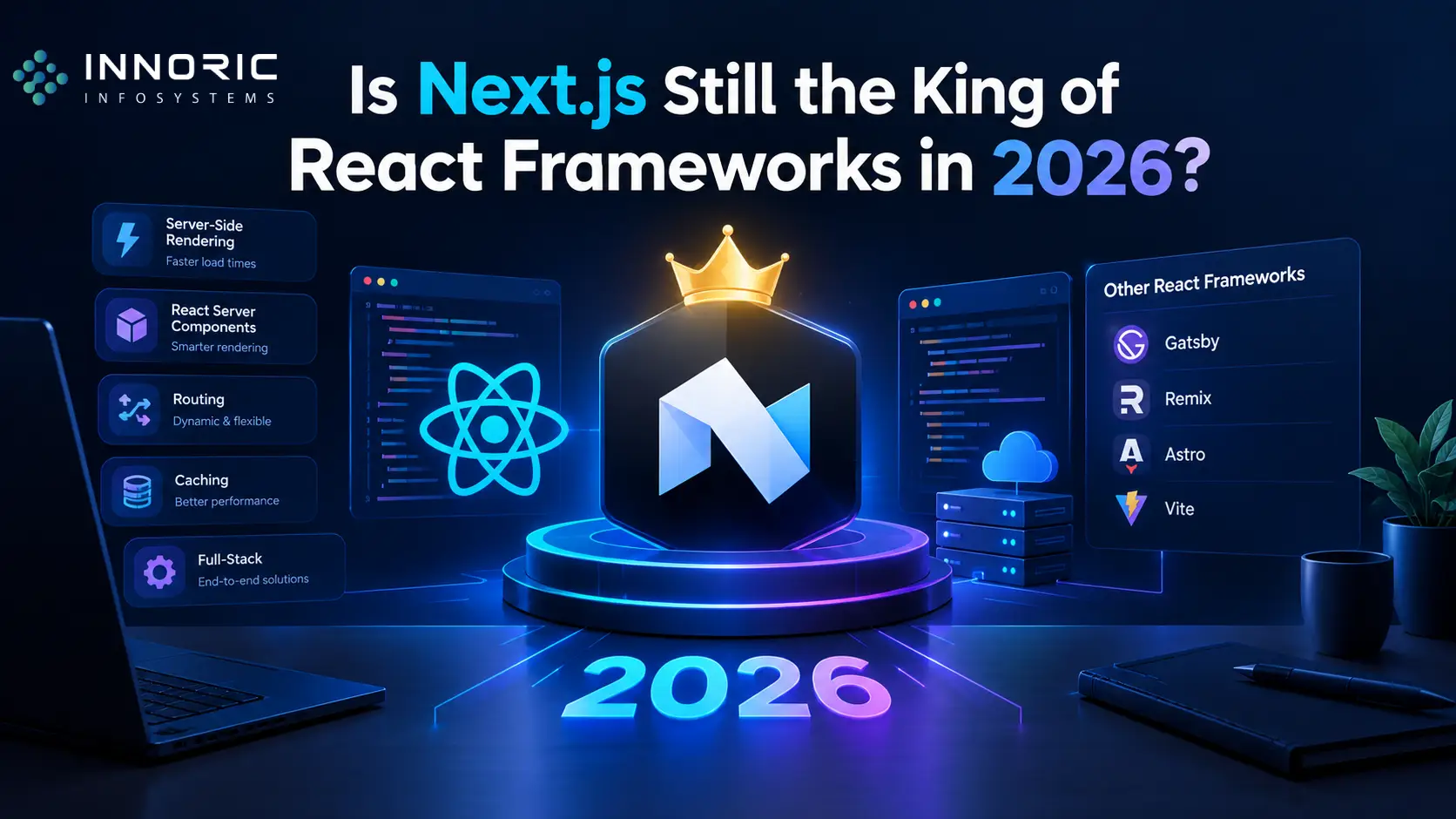
Is Next.js Still the King of React Frameworks in 2026?
Engineering Insights Report by Innoric Infosystems, Gorakhpur
For years Vercel’s Next.js reigned supreme as the de-facto standard in React frameworks, successfully marrying the client-side and server-side in one unified stack for serious production applications.
but the web development world has changed dramatically in the last few years
At Innoric Infosystems we’ve seen the evolution firsthand from our software development division in Gorakhpur – as we strive to create enterprise-grade digital products that are consistently faster than our competitors.
Here is our detailed analysis of where the battle for the React-dominated web is being fought in 2026, how Next.js has changed for the better, and who presents a serious challenge to Vercel’s dominance.
1. The Maturity of React Server Components (RSC)
When Next.js first unveiled React Server Components (RSC) with the App Router, the learning curve was nearly vertical. But in 2026 developers can breathe a sigh of relief – RSCs have matured considerably, allowing you to build web apps that deliver dramatically enhanced performance.
By doing data fetching and rendering on the server and only shipping the minimum required HTML and JavaScript to get interactive, Next.js has fundamentally changed the way developers think about front-end performance.
- Significantly reduced bundle sizes: Your NPM packages no longer need to include all the rendering logic or markdown parsers, since that can reside safely on the server
- Near-instant time-to-interactive (TTI): By reducing the amount of client-side rendering needed, your complex web app feels more like a static landing page.
2. Edge Rendering and Localization
Modern web infrastructure is seeing a fundamental shift towards distributed edge networks, and Next.js has embraced this change with open arms in 2026.
By introducing Edge Rendering, Next.js allows applications to run in hundreds of geographically distributed V8 isolates, rather than relying on centralized cloud servers (e.g. AWS us-east-1).
At Innoric Infosystems, we’ve seen how this approach unlocks tremendous opportunities for performance optimization. When a user in London loads your web application, they’ll get a version that’s been processed in the nearest edge cluster (e.g. UK), dramatically reducing latency compared to a server hosted in the US.
3. The Rise of Remix (and React Router)
While Next.js is undoubtedly the most popular React framework, it’s not without its challenges. One of the main alternatives is Remix (unified with React Router in 2026) which promotes itself as a more modern and flexible approach to full-stack React applications
While Next.js pushes heavily toward the Server Component paradigm, Remix champions a different philosophy: Web Standards and Mutability.
| Feature / Philosophy | Next.js (App Router) | Remix (React Router) |
|---|---|---|
| Data Mutability | Server Actions (RSC native) | Standard HTML Form Actions |
| Caching Layer | Highly aggressive, custom fetch cache | Standard HTTP Cache headers |
| Hosting Model | Optimized natively for Vercel | Completely infrastructure agnostic |
| Routing | File-system layout based | Dynamic nested route configurations |
4. Is Next.js Still the Best Choice?
Clearly Next.js continues to dominate the React framework space in 2026, but it’s no longer an uncontested victory.
While it retains its position as the default choice for most React applications, developers building large-scale applications may want to consider alternatives like Remix for certain use cases, particularly around data mutability and deployment flexibility.
Innoric Infosystems recommends Next.js when you need enterprise-grade applications with complex layout nesting capabilities or a mixture of rendering strategies (ISR/SSG/SSR). However, for high-performance CRUD applications, or if you want to avoid Vercel’s ecosystem lock-in, consider exploring the competitive landscape.
Build Your Next Great Product with Innoric Infosystems
Picking the right framework for your web application can have long-lasting implications for your technical debt, and you should always consult with expert software developers before making this critical decision.
Based in Gorakhpur, Innoric Infosystems offers premier application development services to help you build the best possible digital product. Our specialized frontend architects can help you select the optimal stack (Next.js, Remix etc) to build a high-performance web applications that will give you a lasting competitive advantage.
Need to build a faster web application? 🚀 Let’s talk about your requirements with Innoric Infosystems‘ technical experts.