






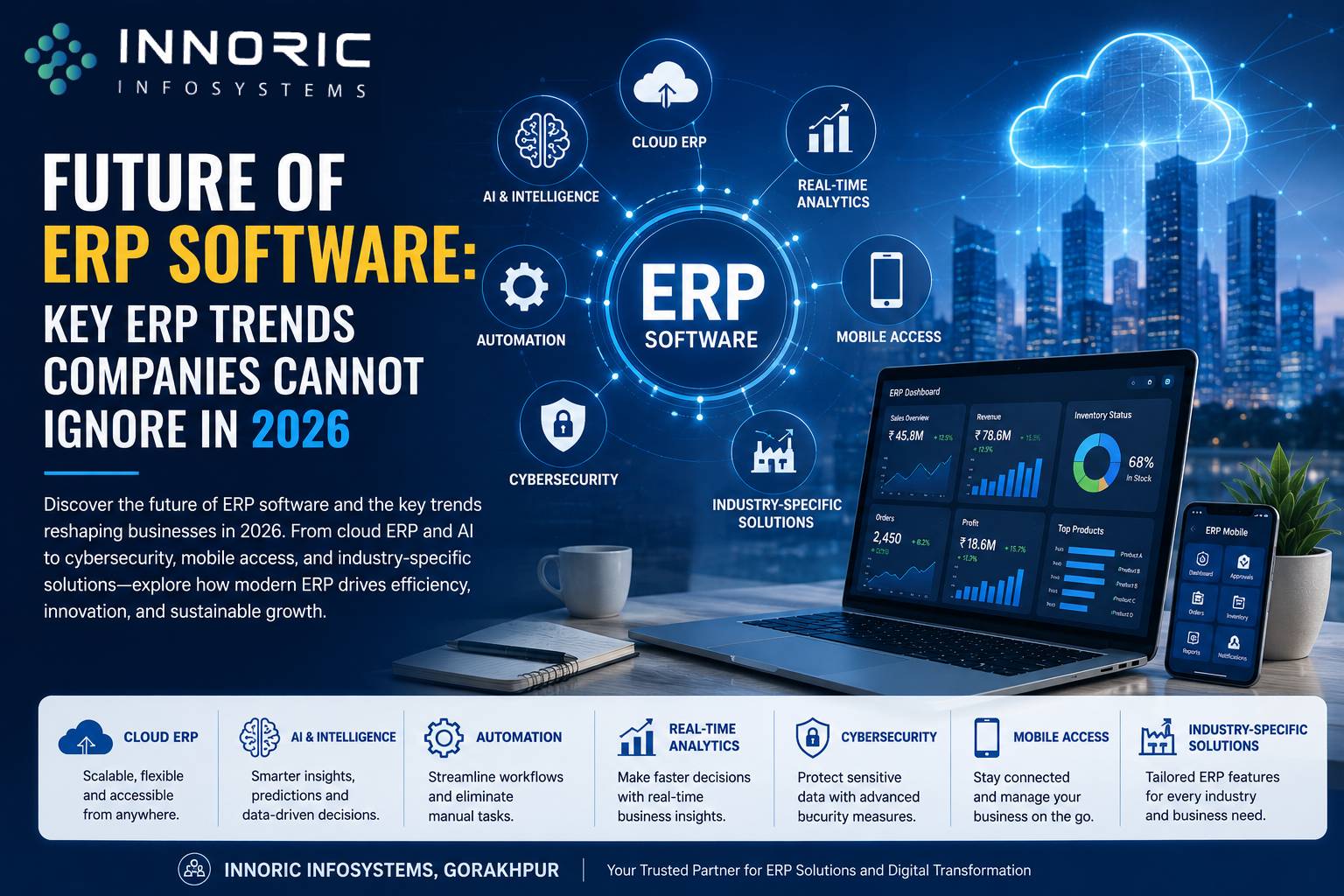
Future of ERP Software: Key ERP Trends Companies Cannot Ignore in 2026
How Modern ERP Technology Is Redefining Business Operations
Enterprise Resource Planning (ERP trends) software is changing rapidly. In 2026, businesses are no longer choosing ERP systems simply to manage accounting, inventory, or reporting. Organizations now expect ERP platforms to deliver intelligence, automation, flexibility, security, and real-time operational visibility.
As digital transformation accelerates across industries, companies must understand which ERP trends are shaping the future of enterprise technology.
At Innoric Infosystems, Gorakhpur, we work with businesses exploring next-generation software solutions that improve operational efficiency, decision-making, and business scalability.
This guide explains the future of ERP software and the key ERP trends companies cannot afford to ignore in 2026.
What Is ERP Software and Why Does It Matter in 2026?
ERP software is an integrated business management system that connects different organizational functions into one centralized platform.
ERP systems typically manage:
- Finance and accounting
- Human resources
- Inventory management
- Supply chain operations
- Procurement
- Sales and CRM integration
- Reporting and analytics
- Project management
Modern ERP platforms help organizations eliminate fragmented workflows and improve collaboration across departments.
Why Businesses Are Investing More in ERP Systems
Businesses face increasing pressure to:
- Improve efficiency
- Reduce operational costs
- Make faster decisions
- Handle complex data environments
- Support remote operations
- Scale effectively
ERP software provides a foundation for managing these challenges through centralized operational control.
Which ERP Trends Are Driving Business Growth in 2026?
Several technology innovations are transforming the ERP market.
Below are the most important ERP trends organizations should monitor.
Trend 1: Artificial Intelligence Is Becoming a Core ERP Capability
Artificial Intelligence is one of the most influential ERP developments in recent years.
Traditional ERP systems focused on storing and processing information. AI-powered ERP systems go much further by analyzing business patterns, identifying risks, and generating predictive insights.
How AI Improves ERP Performance
AI-driven ERP platforms can support:
- Demand forecasting
- Smart inventory optimization
- Financial analysis
- Fraud detection
- Automated reporting
- Customer behavior analysis
- Intelligent workflow automation
For example, an AI-enabled ERP system may forecast supply shortages before they affect operations or recommend purchasing adjustments based on historical sales behavior.
Why Companies Are Adopting AI ERP
Organizations adopting AI within ERP environments often gain:
- Faster business insights
- Better forecasting accuracy
- Reduced manual analysis
- Improved operational planning
- Smarter strategic decisions
AI is transforming ERP from a reporting tool into an intelligent business advisor.
Trend 2: Cloud ERP Is Becoming the Preferred Deployment Model
One of the most important shifts in enterprise technology is the continued growth of cloud ERP.
Traditional on-premise ERP systems can involve:
- High infrastructure costs
- Complex maintenance
- Manual upgrades
- Limited accessibility
Cloud ERP platforms address these challenges by providing software access through secure online environments.
Why Businesses Prefer Cloud ERP
Cloud ERP offers several advantages:
- Lower hardware investment
- Automatic software updates
- Remote accessibility
- Faster deployment
- Easier scalability
- Stronger collaboration support
Businesses managing hybrid teams, multiple offices, warehouses, or remote operations particularly benefit from cloud-based ERP solutions.
How Cloud ERP Supports Business Expansion
Growing organizations require flexible technology infrastructure.
Cloud ERP enables businesses to:
- Add users quickly
- Support expansion into new locations
- Scale operational modules
- Integrate emerging technologies
- Reduce internal IT complexity
At Innoric Infosystems, cloud-ready ERP solutions are increasingly requested by businesses seeking long-term scalability.
Trend 3: Real-Time Analytics Is Reshaping ERP Decision-Making
Business leaders need access to current operational information.
Waiting for weekly or monthly reporting cycles can slow decision-making and reduce responsiveness.
This is why real-time analytics has become a major ERP trend in 2026.
What Does Real-Time ERP Analytics Include?
Modern ERP dashboards may provide visibility into:
- Revenue performance
- Inventory movement
- Financial health
- Operational productivity
- Customer activity
- Procurement trends
- Workforce performance
Executives can access live data instead of relying on outdated reports.
Benefits of Analytics-Driven ERP Systems
Real-time analytics helps organizations:
- Identify operational risks faster
- Improve planning accuracy
- Monitor KPIs continuously
- Increase financial visibility
- Improve resource utilization
Businesses using data-driven ERP systems are often better positioned to respond to changing market conditions.
Trend 4: Automation Is Reducing Manual Business Work
Manual processes continue to slow business productivity.
Modern ERP platforms increasingly focus on workflow automation to reduce repetitive administrative work.
Automation is now a core ERP expectation.
What Processes Can ERP Automation Handle?
ERP systems can automate:
- Invoice approvals
- Payroll management
- Purchase workflows
- Order processing
- Compliance reporting
- Expense management
- Inventory alerts
Automation improves speed while reducing operational errors.
Why Automation Matters for Companies
Companies implementing ERP automation frequently experience:
- Lower administrative workload
- Faster operational cycles
- Improved consistency
- Reduced human error
- Higher productivity levels
Automation enables employees to focus more on strategic activities rather than repetitive data handling.
Trend 5: Industry-Specific ERP Solutions Are Growing Rapidly
Not every organization operates the same way.
Generic software often lacks specialized workflows required by different industries.
Because of this, many companies are adopting industry-focused ERP platforms.
Which Industries Are Driving ERP Specialization?
ERP customization demand is increasing across:
- Manufacturing
- Healthcare
- Education
- Retail
- Logistics
- Construction
- Hospitality
- Distribution
Industry-focused ERP solutions typically include specialized reporting, compliance support, operational workflows, and management tools.
Businesses increasingly prefer ERP software aligned with their operational realities.
Trend 6: Cybersecurity Is Becoming a Critical ERP Priority
As ERP systems manage core business operations, cybersecurity has become a top concern for organizations worldwide.
ERP software stores sensitive business information such as:
- Financial records
- Employee payroll data
- Customer databases
- Vendor information
- Inventory records
- Operational reports
- Compliance documents
Because of the value of this information, ERP platforms must provide strong security controls.
How Modern ERP Security Is Evolving
ERP vendors are strengthening protection through:
- Multi-factor authentication (MFA)
- Data encryption
- Role-based access controls
- Threat monitoring
- Secure cloud infrastructure
- Compliance management tools
- Activity auditing systems
Businesses evaluating ERP platforms in 2026 increasingly prioritize security alongside functionality.
Why ERP Security Matters for Companies
Weak security practices can lead to:
- Data breaches
- Financial losses
- Operational disruption
- Compliance violations
- Reputation damage
Modern ERP investments must support both operational performance and enterprise-grade protection.
Trend 7: Mobile ERP Is Supporting the Anywhere Workforce
The workforce has changed significantly.
Employees no longer operate exclusively from centralized offices. Hybrid work models, field operations, warehouse mobility, and remote collaboration are now common business realities.
This shift is driving rapid growth in mobile ERP adoption.
What Can Mobile ERP Solutions Provide?
Mobile ERP platforms may allow employees to:
- Access operational dashboards
- Review business reports
- Approve transactions
- Monitor inventory levels
- Manage field operations
- View customer information
- Track sales performance
Mobile accessibility increases responsiveness and operational flexibility.
Why Mobile ERP Is Important in 2026
Businesses increasingly need systems that support:
- Remote employees
- Sales mobility
- Multi-location management
- Warehouse operations
- Field service teams
ERP mobility is becoming a standard requirement for organizations pursuing digital agility.
Trend 8: Low-Code and No-Code ERP Customization Is Expanding
Traditional ERP customization can be time-consuming and expensive.
Organizations often require software changes to support evolving business processes, but full-scale development projects may slow innovation.
This challenge has accelerated interest in low-code and no-code ERP platforms.
What Is Low-Code ERP?
Low-code ERP environments allow businesses to configure workflows and features using simplified development approaches.
Organizations may use low-code ERP tools to:
- Customize dashboards
- Configure approval chains
- Modify workflows
- Design internal forms
- Build operational logic
- Create reporting structures
This flexibility helps businesses adapt faster.
Benefits of Low-Code ERP Customization
Companies adopting low-code ERP strategies may gain:
- Faster deployment cycles
- Lower development costs
- Increased agility
- Easier process adaptation
- Reduced technical dependency
Businesses increasingly want ERP systems that evolve alongside changing operational demands.
Trend 9: ERP Integration Is Becoming Essential
Organizations use many software tools across departments.
Without integration, businesses often struggle with disconnected systems and fragmented data environments.
ERP integration is becoming a central requirement in modern enterprise technology planning.
What Does ERP Integration Mean?
ERP integration connects operational software into one unified ecosystem.
Common integrations include:
- ERP + CRM systems
- ERP + HR platforms
- ERP + Accounting software
- ERP + Supply chain tools
- ERP + eCommerce platforms
- ERP + Analytics solutions
Integration improves communication between systems and departments.
Business Benefits of ERP Integration
Integrated ERP environments can support:
- Centralized reporting
- Better data consistency
- Workflow automation
- Faster information sharing
- Improved operational visibility
- Enhanced customer experiences
Organizations increasingly seek ERP systems capable of functioning as connected operational hubs.
Trend 10: Sustainability and ESG Tracking Are Influencing ERP Development
Environmental responsibility is becoming more important for modern businesses.
Organizations are increasingly expected to measure sustainability performance and support ESG (Environmental, Social, and Governance) reporting.
ERP software is adapting to meet these expectations.
How ERP Supports Sustainability Goals
Modern ERP platforms may help organizations track:
- Energy consumption
- Carbon reporting
- Waste reduction
- Supply chain sustainability
- Resource utilization
- Environmental compliance
These capabilities provide operational visibility into sustainability performance.
Why Sustainability ERP Features Matter
Businesses face pressure from:
- Customers
- Investors
- Regulators
- Global supply chain partners
- Corporate governance requirements
ERP systems are evolving into platforms that support both operational management and sustainability accountability.
What Will the Future of ERP Software Look Like?
The future of ERP software will be defined by intelligent, connected, and adaptive systems.
Future ERP platforms will likely emphasize:
- Artificial Intelligence integration
- Predictive analytics
- Advanced automation
- Stronger cybersecurity
- Greater cloud adoption
- Mobile-first accessibility
- Industry specialization
- Sustainable business tracking
Organizations that modernize their ERP strategy will likely gain stronger competitive positioning in increasingly data-driven markets.
How Can Businesses Choose the Right ERP System?
Selecting an ERP platform requires careful planning.
Businesses should evaluate ERP solutions based on several important factors.
Scalability
Can the platform support future growth?
Cloud Readiness
Does the ERP system enable remote access and flexible expansion?
Security Capabilities
Are strong protection measures included?
Integration Support
Can the software connect with existing tools?
Analytics Strength
Does the ERP platform deliver real-time business intelligence?
Industry Alignment
Does the system support your operational requirements?
At Innoric Infosystems, Gorakhpur, businesses increasingly seek ERP solutions that balance functionality, flexibility, scalability, and future readiness.
Conclusion: Businesses Cannot Ignore the Future of ERP
ERP software is evolving from a business management tool into a strategic technology ecosystem.
Artificial Intelligence, cloud infrastructure, automation, analytics, cybersecurity, mobility, and sustainability are redefining how organizations operate.
Companies that embrace these ERP trends can improve efficiency, visibility, scalability, and decision-making capabilities.
Businesses that continue relying on outdated systems may struggle to compete in increasingly digital markets.
Understanding ERP trends is not simply about following technology—it is about preparing organizations for future operational success.
Frequently Asked Questions (FAQs)
What are the top ERP trends in 2026?
Major ERP trends include Artificial Intelligence, cloud ERP, automation, cybersecurity, mobile ERP, low-code development, real-time analytics, and sustainability tracking.
Why is cloud ERP important for businesses?
Cloud ERP provides scalability, accessibility, automatic updates, reduced infrastructure costs, and easier expansion support.
How does AI improve ERP software?
AI improves ERP systems through predictive analytics, intelligent automation, forecasting, smart reporting, and operational recommendations.
Which industries use ERP software?
ERP software is used across manufacturing, retail, healthcare, education, logistics, construction, hospitality, and professional services.
Why do companies invest in ERP systems?
Organizations adopt ERP systems to centralize operations, improve visibility, reduce manual work, automate workflows, and support scalable growth.