






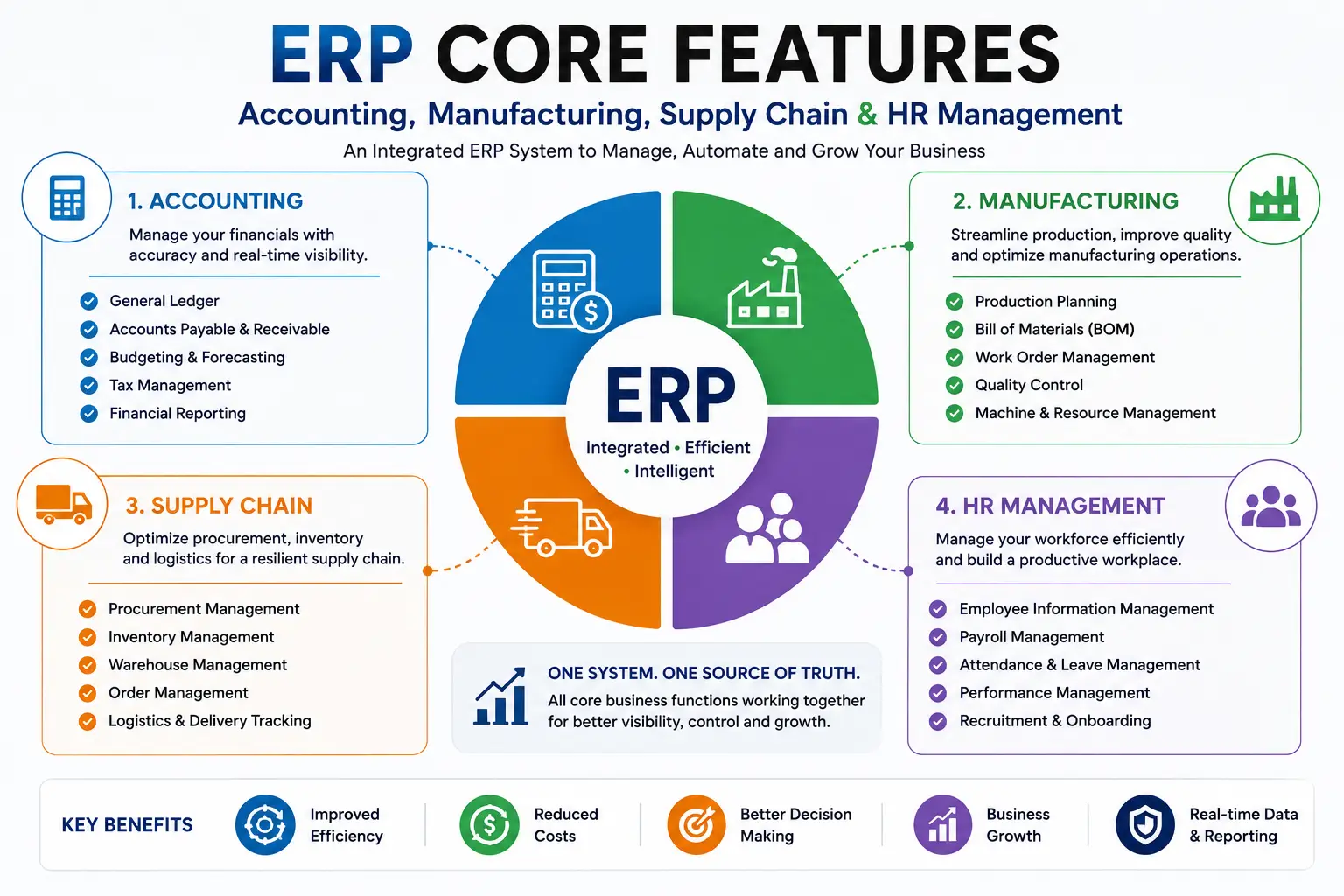
ERP Core Features: Accounting, Manufacturing, Supply Chain & HR Management
Enterprise Resource Planning (ERP) software has become an important technology for businesses that want to manage their operations from a centralized platform. Instead of maintaining separate systems for accounting, inventory, manufacturing, purchasing, payroll, and other departments, an ERP system connects these functions and provides a unified view of business data.
When people search for ERP core features, some of the most important areas they want to understand are accounting, manufacturing, supply chain management, and salary or HR management.
This guide explains these core ERP modules, how they work, and why they are important for modern businesses.
What Is ERP Software?
ERP stands for Enterprise Resource Planning.
ERP software is a centralized business management system that integrates different organizational processes into one platform.
Depending on the business and ERP solution, it can manage:
- Accounting and finance
- Manufacturing
- Inventory
- Supply chain
- Procurement
- Sales
- Human resources
- Payroll and salary
- Projects
- Customer management
- Reporting and analytics
The main purpose of ERP is to connect departments so that employees can work with consistent and centralized information.
What Are the Core Features of ERP?
Although ERP functionality varies by industry, the following are some of the most important ERP modules.
1. Accounting and Financial Management
Accounting is one of the most important components of an ERP system.
An ERP accounting module can help businesses manage financial transactions across departments and locations.
Key Accounting Features
- General ledger
- Accounts payable
- Accounts receivable
- Invoicing
- Expense management
- Payment tracking
- Bank reconciliation
- Tax management
- Financial reporting
- Budget management
- Cash-flow monitoring
For example, when a company purchases raw materials, the transaction can be recorded in the ERP system and connected with procurement, inventory, and accounting.
This reduces the need to enter the same information into multiple systems.
Why Is ERP Accounting Important?
An integrated accounting system can provide management with a clearer view of:
- Revenue
- Expenses
- Outstanding payments
- Supplier liabilities
- Cash flow
- Profitability
Instead of waiting for different departments to submit separate reports, management can access centralized financial information.
2. Manufacturing Management
Manufacturing businesses often have complex processes involving raw materials, production planning, machines, employees, warehouses, and finished products.
An ERP system can bring these activities together.
Key Manufacturing ERP Features
- Production planning
- Work orders
- Bill of Materials (BOM)
- Material Requirements Planning (MRP)
- Production scheduling
- Raw-material management
- Work-in-progress tracking
- Finished-goods management
- Quality control
- Machine/resource planning
- Production reporting
Example of Manufacturing ERP
Consider a company manufacturing furniture.
The process could be:
Customer Order → Production Planning → Raw Materials → Work Order → Manufacturing → Quality Check → Finished Goods → Delivery
An ERP system can connect these stages and provide visibility into production status.
Benefits of Manufacturing ERP
Manufacturing ERP can help businesses:
- Reduce production delays
- Improve material planning
- Monitor production costs
- Track work orders
- Reduce inventory problems
- Improve production visibility
- Coordinate different departments
3. Supply Chain Management
Supply chain management is another major ERP functionality.
A company’s supply chain may include suppliers, procurement, warehouses, transportation, inventory, production, and customers.
ERP software can connect these processes.
Key Supply Chain Features
- Supplier management
- Purchase orders
- Procurement
- Inventory management
- Warehouse management
- Stock transfers
- Demand planning
- Order management
- Shipment tracking
- Logistics management
- Supplier performance tracking
How ERP Connects the Supply Chain
A typical process might look like:
Demand → Purchase → Supplier → Warehouse → Production → Finished Goods → Shipment → Customer
Because the information is centralized, teams can better understand what has been ordered, what is available, and what needs to be purchased.
4. Inventory Management
Inventory is closely connected to manufacturing and supply chain operations.
ERP inventory management can help businesses track products and materials across warehouses and locations.
Common Inventory Features
- Stock tracking
- Multi-warehouse management
- Stock transfers
- Batch management
- Serial numbers
- Barcode integration
- Reorder levels
- Goods receipt
- Goods issue
- Inventory valuation
- Stock reports
For businesses handling large quantities of products, accurate inventory data can be essential for preventing overstocking and stockouts.
5. Procurement Management
ERP procurement modules help businesses manage purchasing activities.
The process can include:
Purchase Request → Approval → Purchase Order → Goods Receipt → Supplier Invoice → Payment
Procurement Features
- Supplier database
- Purchase requisitions
- Purchase orders
- Approval workflows
- Supplier quotations
- Goods receipt
- Supplier invoices
- Purchase reports
- Vendor performance
Integrating procurement with inventory and accounting can reduce manual work and improve purchasing visibility.
6. HR and Salary Management
HR and payroll management is another important ERP function.
Businesses need to manage employees, attendance, leave, salaries, deductions, benefits, and other workforce-related information.
An ERP HR module can centralize this information.
Key HR Features
- Employee records
- Employee onboarding
- Attendance management
- Leave management
- Payroll
- Salary calculation
- Bonuses and incentives
- Deductions
- Employee documents
- Performance management
- Recruitment
- HR reports
7. Salary and Payroll Management
When people search for ERP salary management, they are generally looking for payroll functionality.
Payroll software within an ERP can help calculate employee salaries based on organizational rules and available employee data.
A typical payroll process may include:
Employee Data → Attendance → Leave → Salary Calculation → Deductions → Payroll → Payslip
Depending on the implementation, the system can account for components such as:
- Basic salary
- Allowances
- Bonuses
- Incentives
- Deductions
- Leave adjustments
- Overtime
- Statutory components
Payroll requirements vary by country and organization, so businesses should configure ERP payroll according to applicable regulations and professional accounting/HR requirements.
8. Sales and Order Management
ERP systems can also manage sales orders and connect them with inventory, fulfillment, and finance.
Sales ERP Features
- Customer records
- Quotations
- Sales orders
- Pricing
- Discounts
- Invoicing
- Order tracking
- Delivery management
- Sales reports
For example:
Quotation → Sales Order → Inventory → Delivery → Invoice → Accounting
This creates a connected sales-to-finance workflow.
9. Business Reporting and Analytics
One of the biggest advantages of ERP is centralized business data.
Management can use dashboards and reports to monitor:
- Sales
- Revenue
- Expenses
- Inventory
- Production
- Procurement
- Employee costs
- Profitability
- Cash flow
- Business performance
Instead of relying entirely on manually prepared spreadsheets, managers can use system-generated reports based on centralized data.
10. Multi-Branch and Multi-Location Management
Businesses operating across multiple branches or warehouses may need centralized ERP management.
An ERP system can potentially provide:
- Branch-wise reporting
- Centralized accounting
- Multi-warehouse inventory
- Stock transfers
- User permissions
- Consolidated reports
- Location-wise sales
This can be especially useful for growing organizations.
ERP Core Features at a Glance
| ERP Module | Major Functions |
|---|---|
| Accounting | Finance, invoices, payments, expenses, reporting |
| Manufacturing | Production planning, BOM, work orders, MRP |
| Supply Chain | Procurement, logistics, suppliers, inventory |
| Inventory | Stock, warehouses, transfers, batches |
| HR | Employee records, attendance, leave |
| Payroll | Salary, deductions, payslips, incentives |
| Sales | Quotations, orders, invoicing |
| Procurement | Vendors, purchase orders, approvals |
| Analytics | Dashboards, reports, business insights |
How ERP Modules Work Together
The real value of ERP is not simply having many modules. It is the integration between those modules.
For example, a manufacturing business receives a customer order.
Step 1: Sales
The sales team creates the order.
Step 2: Inventory
The ERP checks whether the required products are available.
Step 3: Procurement
If raw materials are insufficient, the procurement team can initiate purchasing.
Step 4: Manufacturing
Production receives the required work order.
Step 5: Warehouse
Finished products are added to inventory.
Step 6: Delivery
The order is dispatched to the customer.
Step 7: Accounting
The invoice and financial transaction are recorded.
This creates a connected business workflow:
Sales → Inventory → Procurement → Manufacturing → Warehouse → Delivery → Accounting
Why Are ERP Core Features Important for Businesses?
A properly implemented ERP system can provide several benefits.
Centralized Information
Departments can work from a common source of business data.
Reduced Manual Work
Automation can reduce repetitive data entry and administrative processes.
Better Decision-Making
Management can access consolidated information for business analysis.
Improved Inventory Control
Businesses can monitor stock levels and movement more effectively.
Better Financial Visibility
Accounting information can be connected with operational transactions.
Improved Employee Management
HR and payroll processes can be managed through centralized employee data.
Greater Operational Efficiency
Integrated workflows can reduce unnecessary duplication between departments.
ERP Core Features for Different Industries
Manufacturing
Important modules include:
- Production
- Inventory
- Procurement
- Supply chain
- Quality
- Accounting
- HR
Retail
Retail businesses may prioritize:
- Inventory
- Sales
- Purchasing
- Accounting
- Customer management
- Multi-store management
Healthcare
Healthcare organizations may require specialized systems alongside ERP functions for:
- Finance
- HR
- Procurement
- Inventory
- Administration
Education
Educational organizations may use ERP-like systems for:
- Fees
- Accounting
- HR
- Payroll
- Administration
- Procurement
FMCG
FMCG businesses often need strong:
- Inventory
- Distribution
- Procurement
- Sales
- Supply chain
- Warehouse
- Accounting
ERP vs Separate Software Systems
Without ERP, a company might use:
Excel + Accounting Software + HR Software + Inventory Software + Procurement Software + Separate Reporting Tools
This can create disconnected information.
With an integrated ERP:
Accounting + HR + Inventory + Procurement + Manufacturing + Supply Chain + Reporting
can operate within one connected ecosystem.
However, implementing ERP is a significant business and technology project. Businesses should evaluate their processes and requirements before selecting a platform.
Should a Business Choose Custom ERP Software?
Not every business needs a completely custom ERP.
A company can generally consider three approaches:
1. Ready-Made ERP
Suitable when standard functionality closely matches business requirements.
2. Configured or Customized ERP
An existing ERP platform can be configured or extended to meet specific workflows.
3. Custom ERP Development
Best Custom ERP software in Gorakhpur can be developed when an organization’s processes are highly specialized or existing platforms cannot adequately support its requirements.
Custom ERP may be useful for businesses requiring:
- Industry-specific workflows
- Custom dashboards
- Unique approval processes
- Multiple branches
- Specialized inventory
- Custom integrations
- Mobile applications
- Existing software integration
Frequently Asked Questions About ERP Core Features
What are the main features of ERP software?
The main ERP features commonly include accounting, finance, inventory, procurement, manufacturing, supply chain, sales, HR, payroll, and business reporting.
Does ERP include accounting?
Yes. Accounting and financial management are core functions in many ERP systems, including areas such as invoicing, expenses, accounts payable, accounts receivable, and financial reporting.
Can ERP manage manufacturing?
Yes. Manufacturing ERP can support production planning, bills of materials, work orders, material requirements planning, production scheduling, and related processes.
Can ERP manage supply chain?
Yes. ERP can connect procurement, suppliers, inventory, warehouses, production, logistics, and order fulfillment.
Can ERP software calculate employee salaries?
Many ERP systems include HR and payroll modules that can manage salary calculations, deductions, attendance, leave, and payslips. Exact payroll functionality depends on the ERP platform and local requirements.
Is ERP suitable for small businesses?
ERP can be suitable for small and medium-sized businesses when they have sufficiently complex operations or need integrated management of finance, inventory, HR, procurement, manufacturing, or other processes.
What is the most important ERP feature?
There is no single most important feature. The value of ERP comes from integrating the processes that are most critical to the business.
Conclusion
ERP software is much more than an accounting or inventory system. It is an integrated business management platform that can connect financial, operational, workforce, manufacturing, and supply-chain processes.
The core ERP features most businesses look for include:
Accounting & Finance → Manufacturing → Supply Chain → Inventory → Procurement → HR → Salary & Payroll → Sales → Reporting
The right ERP solution should be selected based on the organization’s industry, business processes, number of users, scalability requirements, integrations, budget, and long-term objectives.
For businesses moving toward digital transformation, an integrated ERP system can provide a foundation for better operational visibility, process automation, centralized data, and more informed decision-making.