



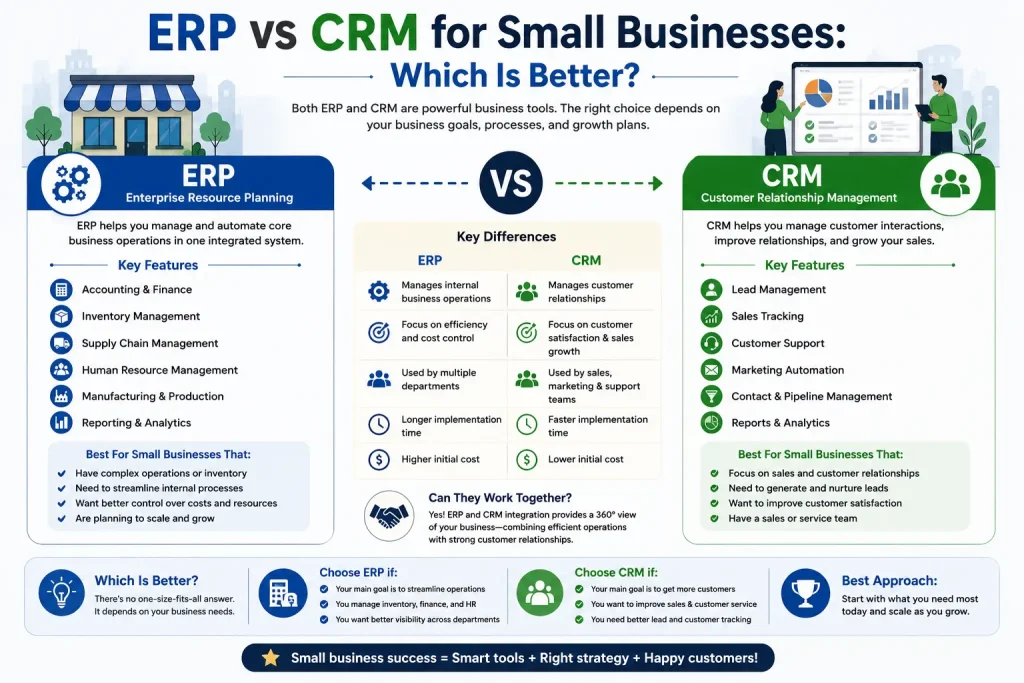
ERP vs CRM for Small Businesses: Which Is Better?
Small businesses often face an important question when choosing business management software:
“Should I invest in ERP or CRM software?”
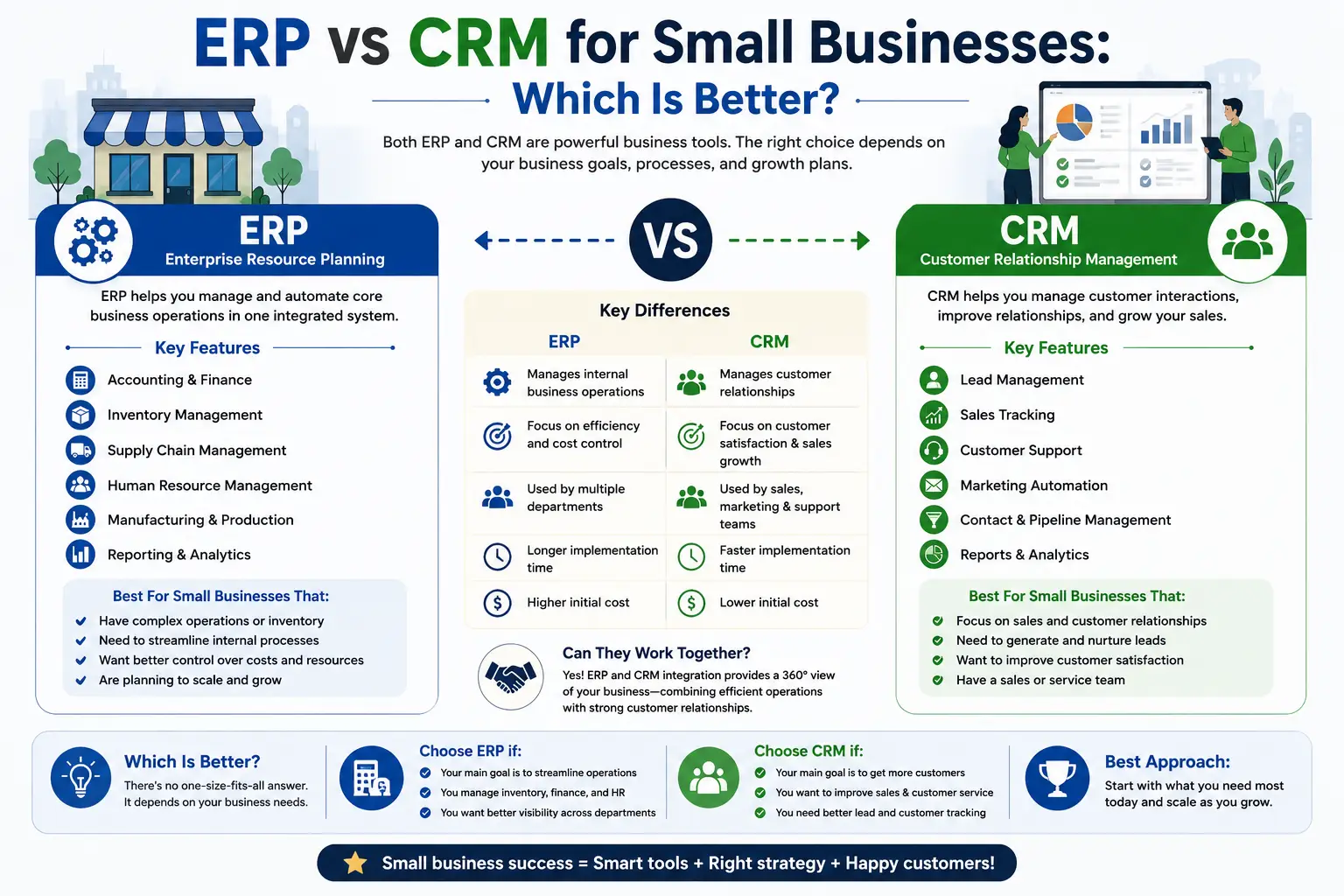
The answer depends on what the business needs to improve. CRM (Customer Relationship Management) is generally more useful when the main priority is getting leads, managing customers, tracking sales, and improving follow-ups. ERP (Enterprise Resource Planning) is more useful when the business needs to manage accounting, inventory, purchasing, manufacturing, HR, payroll, or other internal operations.
For many small businesses, starting with a CRM can be simpler if sales and customer management are the biggest challenges. However, businesses with complex operational requirements may benefit more from ERP—or eventually use both ERP and CRM together.
What Is CRM Software?
CRM stands for Customer Relationship Management.
CRM software helps businesses manage the customer journey from the first inquiry to sales and ongoing customer relationships.
Common CRM features include:
- Lead generation
- Contact management
- Sales tracking
- Sales pipeline management
- Customer follow-ups
- Marketing automation
- Customer support
- Email management
- Customer segmentation
- Sales reporting
For example:
Website Visitor → Lead → Follow-Up → Proposal → Customer
A CRM helps the sales team manage this entire process.
What Is ERP Software?
ERP stands for Enterprise Resource Planning.
ERP software focuses on managing the internal operations and resources of a business.
Common ERP modules include:
- Accounting
- Finance
- Inventory
- Procurement
- Manufacturing
- Supply chain
- HR
- Payroll
- Warehouse management
- Business reporting
For example:
Purchase → Inventory → Production → Warehouse → Delivery → Invoice → Accounting
An ERP connects these internal processes through a centralized system.
ERP vs CRM for Small Business
The fundamental difference is what each system is designed to manage.
| CRM | ERP |
|---|---|
| Customer-focused | Operations-focused |
| Leads | Accounting |
| Sales | Inventory |
| Customer relationships | Procurement |
| Marketing | Manufacturing |
| Follow-ups | Supply chain |
| Customer support | HR & payroll |
| Sales reporting | Financial reporting |
In simple terms:
CRM helps you get and retain customers.
ERP helps you run and control the business.
When Should a Small Business Choose CRM?
CRM is often the better starting point when the biggest challenge is sales and customer management.
A small business may benefit from CRM if:
- Leads are being lost
- Salespeople forget follow-ups
- Customer information is stored in spreadsheets
- Sales opportunities are difficult to track
- Marketing campaigns are not organized
- Managers lack sales visibility
- Customer communication is scattered
- The business wants to improve lead conversion
Example
Imagine a small web development company receiving 50 inquiries every month.
Without CRM, leads might be stored across:
- Phone contacts
- Excel files
- Individual salesperson notes
A CRM can bring these leads into one system:
Lead → Assigned Salesperson → Follow-Up → Proposal → Negotiation → Won/Lost
For a sales-driven small business, this can provide significant value.
When Should a Small Business Choose ERP?
ERP becomes more relevant when the main challenge is managing internal business operations.
A small business may need ERP when it has:
- Complex inventory
- Multiple warehouses
- Manufacturing operations
- Large procurement processes
- Accounting complexity
- Multiple branches
- Supply-chain requirements
- Significant employee/payroll administration
- Complex operational reporting
Example
Consider a small manufacturing company.
It may need to manage:
Raw Materials → Purchasing → Inventory → Production → Quality → Finished Goods → Warehouse → Sales → Accounting
A CRM alone cannot effectively manage all these internal processes.
An ERP would be more appropriate.
CRM or ERP: Which Is More Affordable for a Small Business?
There is no universal answer.
The total cost depends on:
- Number of users
- Features required
- SaaS subscription or custom development
- Number of modules
- Integrations
- Data migration
- Customization
- Implementation
- Training
- Maintenance
A small business should avoid paying for functionality it does not need.
For example, a five-person service business may not need a large ERP system if its primary requirement is lead and customer management.
Similarly, a small manufacturer with complex inventory and production requirements may outgrow a basic CRM quickly.
CRM Is Often a Good Starting Point for Service Businesses
Many small service-based businesses can benefit from starting with CRM.
Examples include:
- Digital marketing agencies
- Web development companies
- Software companies
- Consultants
- Real estate agencies
- Insurance agencies
- Coaching businesses
- Professional services
- Recruitment agencies
These businesses often depend heavily on leads, sales conversations, follow-ups, proposals, and customer relationships.
CRM can organize these activities without requiring a full ERP implementation.
ERP Can Be Better for Product-Based Businesses
Product-based businesses often have more complex operational requirements.
Examples include:
- Manufacturers
- Distributors
- Wholesalers
- Retailers
- FMCG businesses
- Import/export businesses
They may need to manage:
Purchasing + Inventory + Warehouse + Supply Chain + Accounting + Production
In these situations, ERP can provide greater value.
What About a Small E-Commerce Business?
E-commerce businesses can potentially benefit from both CRM and ERP, depending on their scale.
CRM Can Manage:
- Customer profiles
- Marketing
- Repeat customers
- Customer support
- Promotions
- Lead/customer segmentation
ERP Can Manage:
- Inventory
- Procurement
- Order processing
- Warehouse
- Accounting
- Shipping
- Supplier management
A growing e-commerce business may eventually need both systems to manage the customer-facing and operational sides of the business.
Can a Small Business Use Both ERP and CRM?
Yes.
ERP and CRM are not competing technologies.
They can work together.
For example:
CRM
Customer → Lead → Sales → Order
↓
ERP
Inventory → Procurement → Fulfillment → Invoice → Accounting
↓
CRM
Customer Follow-Up → Support → Repeat Sales
This creates a connected customer-to-business workflow.
Benefits of CRM for Small Businesses
1. Better Lead Management
All potential customers can be organized in one place.
2. Improved Follow-Ups
Sales teams can schedule and track follow-up activities.
3. Better Sales Visibility
Managers can see opportunities at different stages.
4. Centralized Customer Information
Customer details and interaction history can be accessed by authorized team members.
5. Marketing Automation
Businesses can automate selected campaigns and customer communications.
6. Better Customer Service
Support teams can access relevant customer information and interaction history.
Benefits of ERP for Small Businesses
1. Centralized Business Operations
Multiple departments can work from connected data.
2. Better Inventory Management
Businesses can monitor stock levels and movement.
3. Improved Accounting
Financial transactions can be connected to operational activities.
4. Better Procurement
Purchasing can be managed through structured workflows.
5. HR and Payroll Management
Employee information, attendance, and salary processes can be centralized.
6. Better Business Reporting
Management can access information about operations and financial performance.
How to Decide Between ERP and CRM
Ask yourself one simple question:
“What is the biggest problem my business has right now?”
If the answer is:
“We are losing leads and struggling to manage sales.”
→ CRM is likely the better starting point.
If the answer is:
“We cannot properly manage inventory, accounting, procurement, or production.”
→ ERP may be more appropriate.
If the answer is:
“We have problems on both sides.”
→ Consider ERP + CRM integration.
Quick Decision Guide
| Business Requirement | Recommended System |
|---|---|
| Lead generation | CRM |
| Sales tracking | CRM |
| Customer management | CRM |
| Marketing automation | CRM |
| Customer support | CRM |
| Accounting | ERP |
| Inventory | ERP |
| Procurement | ERP |
| Manufacturing | ERP |
| Supply chain | ERP |
| Payroll | ERP |
| Complex internal operations | ERP |
| Customer + internal operations | ERP + CRM |
What Should a Small Business Implement First?
There is no one-size-fits-all implementation sequence.
However, a practical approach is to start with the highest-value business problem.
If Sales Is the Priority
Start with CRM.
Then consider ERP as operational complexity increases.
If Operations Are the Priority
Start with ERP.
CRM can be added when customer and sales processes become more complex.
If Both Are Critical
Evaluate an integrated ERP + CRM solution.
This approach can prevent a business from purchasing an unnecessarily complex platform before it actually needs it.
Custom ERP and CRM for Small Businesses
Small businesses sometimes have workflows that don’t fit standard software.
For example, a company may require:
- Custom sales pipelines
- Industry-specific inventory
- Custom approval workflows
- Multiple branches
- Specialized reports
- Website integration
- Payment integration
- WhatsApp integration
- Custom customer portals
- Mobile applications
In such cases, businesses can consider custom ERP or CRM development or customization of an existing platform.
The right approach depends on the complexity of the requirements and the available budget.
Frequently Asked Questions
Is CRM or ERP better for a small business?
Neither is universally better. CRM is generally more suitable when sales and customer management are the main priorities, while ERP is more suitable when accounting, inventory, procurement, manufacturing, HR, or other internal operations are the main challenges.
Should a small business start with CRM?
A CRM can be a good starting point for service businesses and sales-driven companies that need better lead management, sales tracking, and customer relationships.
Does a small business really need ERP?
Not every small business needs ERP. It becomes more useful when operational complexity makes separate spreadsheets or disconnected systems difficult to manage.
Can CRM replace ERP?
No. CRM and ERP have different primary purposes. CRM focuses on customers and sales, while ERP focuses on internal business operations.
Can ERP replace CRM?
Some ERP systems include CRM functionality, but dedicated CRM capabilities may be more extensive depending on the business and platform.
Can ERP and CRM work together?
Yes. Integration can connect customer-facing activities such as sales with internal processes such as inventory, fulfillment, accounting, and procurement.
Which is better for a small manufacturing business?
ERP is often more important for manufacturing because it can manage inventory, procurement, production, supply chain, and accounting. CRM can be added for sales and customer relationship management.
Which is better for a small service business?
CRM is often a strong starting point for service businesses because lead generation, sales tracking, follow-ups, and customer relationships are usually central to their operations.
Conclusion
So, is ERP or CRM better for a small business?
The answer depends on what the business needs to manage.
Choose CRM when your priority is customers, leads, sales, marketing, and support.
Choose ERP when your priority is accounting, inventory, procurement, manufacturing, supply chain, HR, and internal operations.
And if your business has significant requirements in both areas, ERP and CRM can work together.
The best software investment is not necessarily the most feature-rich platform. It is the system that solves your current business problems, fits your processes, can scale with your organization, and provides measurable value as your business grows.