






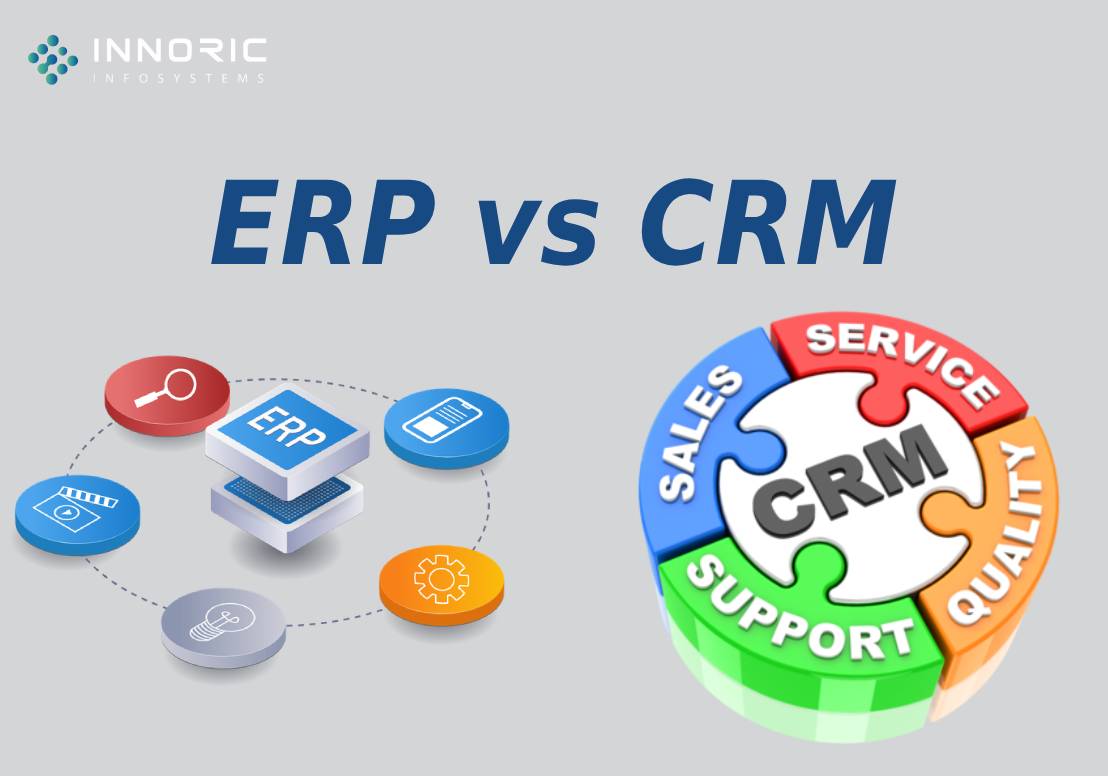
ERP vs CRM: Key Differences, Benefits & Which System Your Business Needs
Organizations aiming to automate and streamline their operations typically evaluate two major software solutions: Enterprise Resource Planning (ERP) vs Customer Relationship Management (CRM).
While both systems play a critical role in business management, they are designed to support different functions.
ERP software helps businesses manage internal operations by connecting financial, operational, and resource management processes through a centralized database. It supports areas such as finance, inventory, procurement, HR, and supply chain management.
CRM software, on the other hand, focuses on managing customer interactions, sales activities, marketing efforts, and customer service relationships.
Both ERP and CRM systems act as centralized data repositories and often serve multiple departments within an organization. Although some vendors offer integrated platforms combining both capabilities, many businesses purchase ERP and CRM separately and connect them through system integrations.
What Is CRM (Customer Relationship Management)?
CRM, or Customer Relationship Management, is software designed to manage every stage of the customer journey and improve business interactions with prospects and existing customers.
Originally developed to support sales teams through Sales Force Automation (SFA), CRM technology gradually expanded to include customer service, marketing automation, and contact center management.
Modern CRM systems commonly support:
- Lead and contact management
- Sales pipeline tracking
- Marketing automation
- Customer service management
- Customer communication tracking
- Sales reporting and forecasting
Some advanced CRM solutions also include tools for sales performance monitoring and incentive compensation management.
The main objective of CRM is to strengthen customer relationships, improve sales performance, and enhance customer engagement.
What Is ERP (Enterprise Resource Planning)?
ERP, or Enterprise Resource Planning, evolved from manufacturing resource planning systems designed to manage business resources efficiently.
Today, ERP acts as a centralized operational platform connecting multiple departments through a shared database.
Core ERP functionality typically includes:
- Financial management and accounting
- General ledger, accounts payable, and accounts receivable
- Payroll and financial reporting
- Inventory and order management
- Supply chain and procurement management
- Production, distribution, and fulfillment operations
Many modern ERP systems may also include modules for human resources, CRM functionality, and eCommerce operations.
ERP helps organizations improve efficiency, strengthen operational visibility, and create better coordination across business functions.
CRM Benefits: Why Businesses Use CRM Software
The primary advantage of CRM software is creating a centralized hub for all customer information and interactions. By consolidating customer data in one platform, businesses gain deeper visibility into customer behavior, sales performance, and service activities.
With access to accurate insights and analytics, organizations can make smarter decisions regarding sales opportunities, customer retention strategies, marketing performance, and service delivery.
Key Benefits of CRM Software
Centralized Customer Data
CRM systems store customer information, communication records, purchase history, and interaction details in a single location.
This enables teams to access complete customer profiles quickly and efficiently.
Improved Sales Performance
Sales teams can track leads, monitor pipelines, manage opportunities, and follow customer interactions more effectively.
This supports stronger forecasting, higher productivity, and improved conversion rates.
Better Customer Service Management
Customer support teams gain instant access to customer histories, allowing them to deliver faster, more personalized, and context-driven support.
For example, customer service representatives can identify high-value customers and provide priority assistance when needed.
Enhanced Collaboration Across Teams
CRM systems improve coordination between departments such as sales, marketing, and customer service by giving all teams access to shared customer information.
Smarter Decision-Making Through Analytics
Businesses can use CRM analytics to understand:
- Customer purchasing behavior
- Sales performance trends
- Marketing effectiveness
- Customer retention opportunities
- Revenue growth potential
ERP Benefits: Why Businesses Invest in ERP Systems
The main strength of an ERP system lies in its ability to create a unified database for operational and financial information.
By connecting departments and automating workflows, ERP enables organizations to improve visibility, efficiency, and data accuracy.
Improved Reporting and Business Visibility
ERP systems simplify reporting by providing a single source of operational and financial truth.
Organizations can generate:
- Monthly reports
- Operational dashboards
- Financial summaries
- Custom management reports
Without relying heavily on manual spreadsheet analysis.
Faster Data-Driven Decision Making
Because ERP centralizes business information, managers and leadership teams can access real-time insights quickly.
This helps organizations respond faster to opportunities, operational issues, and strategic planning needs.
Accelerated Financial Closing Processes
Many organizations implement ERP systems to reduce the time required for financial closing.
Traditional accounting systems and spreadsheets often involve:
- Manual calculations
Departmental follow-ups
- Duplicate data entry
- Complex reconciliations
ERP automation streamlines these activities, allowing finance teams to complete month-end or quarter-end close processes more efficiently.
Stronger Financial Control and Security
ERP systems improve governance through:
- Role-based permissions
- Controlled data access
Audit trails
- Financial monitoring
These capabilities help reduce financial risk and improve compliance.
Improved Operational Efficiency
ERP systems support greater coordination across:
- Inventory management
- Procurement
- Production planning
- Supply chain management
- Order fulfillment
This leads to smoother business operations and better resource utilization.
Best ERP vs CRM: Key Differences Explained
Although ERP and CRM are both essential business management solutions, their primary focus, users, and functionality differ considerably.
Business Focus
CRM software centers on customer engagement, sales activities, marketing, and customer service management.
ERP software focuses on operational management, financial processes, inventory, and internal business functions.
Primary Users
CRM is typically used by:
- Sales departments
- Marketing teams
- Customer service professionals
- Account managers
ERP is commonly used by:
- Finance departments
- Operations managers
- HR teams
- Procurement departments
- Supply chain professionals
Type of Data Managed
CRM manages:
- Customer information
- Lead records
- Sales pipelines
- Communication history
- Marketing campaigns
ERP manages:
- Financial records
- Operational workflows
- Inventory data
- Payroll information
- Procurement and supply chain data
A simple way to understand the difference:
CRM is generally considered a front-office system focused on customers.
ERP is typically viewed as a back-office system centered on operations and finance.
How Are ERP and CRM Similar?
Although ERP and CRM systems serve different business functions, they share several important similarities.
Both are enterprise business applications designed to collect, store, manage, and analyze organizational data.
Centralized Data Management
ERP and CRM platforms both operate using centralized databases that organize critical business information in one place.
This allows organizations to improve data accuracy, reduce duplication, and strengthen reporting capabilities.
Multi-Department Business Support
Both systems impact multiple areas of an organization.
CRM supports departments such as:
- Sales
- Marketing
- Customer support
ERP supports departments including:
- Finance
- Operations
- Human resources
- Procurement
- Supply chain management
Cloud and SaaS Availability
Modern ERP and CRM systems are commonly available through:
- Cloud deployment
- Software-as-a-Service (SaaS) models
- On-premises installations
Cloud adoption enables businesses to access systems remotely, reduce infrastructure requirements, and improve scalability.
Data Analytics and Reporting Capabilities
Both ERP and CRM platforms help organizations analyze business performance through dashboards, reports, forecasting, and performance insights.
Do You Need ERP, CRM, or Both?
For many growing businesses, the answer is eventually both.
However, the right starting point depends on business priorities, operational complexity, and growth objectives.
When to Choose CRM First
A business may prioritize CRM if it needs stronger support for:
- Lead management
- Customer communication
- Sales performance tracking
- Marketing automation
- Customer retention initiatives
Organizations with large customer bases and active sales cycles often adopt CRM systems early.
When to Choose ERP First
ERP may be the better first investment when businesses require:
- Stronger financial management
- Operational visibility
- Inventory tracking
- Procurement management
- Resource planning
Companies dealing with operational complexity, inventory control, or financial reporting challenges often begin with ERP.
Why Many Businesses Use Both
As organizations expand, customer management and internal operations become increasingly connected.
Using ERP and CRM together allows businesses to create stronger alignment between:
- Sales performance
- Customer experience
- Financial management
- Operational efficiency
- Business reporting
For most growing companies, both systems eventually become essential components of digital business management.
Key Features of ERP vs CRM
| ERP Features | CRM Features |
|---|---|
| Financial Management & Accounting | Sales Force Automation |
| Inventory Management | Lead & Contact Management |
| Order Management | Customer Service Management |
| Procurement Management | Marketing Automation |
| Supply Chain Management | Customer Communication Tracking |
| Production & Operations Planning | Sales Pipeline Management |
| Payroll & Financial Reporting | Customer Self-Service Tools |
| Warehouse & Fulfillment Management | Reporting & Sales Forecasting |
Integration of ERP and CRM Systems
ERP and CRM systems often need to exchange information across departments.
Rather than maintaining separate datasets, businesses typically benefit from connecting the two systems through integration.
Why ERP and CRM Integration Matters
Integration allows teams to access consistent information across the organization.
For example:
A sales representative may need access to:
- Customer order history
- Credit information
- Outstanding balances
- Payment status
before proposing upsell or cross-sell opportunities.
At the same time, finance teams may require CRM data for:
- Sales commission calculations
- Discount analysis
- Revenue reporting
Benefits of ERP and CRM Integration
Organizations integrating ERP and CRM systems often experience:
Unified Business Data
Departments work with shared, synchronized information across operational and customer workflows.
Better Customer Visibility
Businesses gain a more complete understanding of customer transactions, financial standing, purchase history, and service activity.
Improved Workflow Automation
Integration supports smoother processes between:
- Sales
- Finance
- Customer service
- Inventory management
- Order fulfillment
Stronger Reporting and KPI Management
Business leaders can analyze important metrics such as:
- Customer acquisition cost (CAC)
- Customer lifetime value (CLV)
- Sales performance
- Operational profitability
using consolidated data sources.
Unified ERP and CRM Solutions: A Smarter Business Approach
Many organizations prefer unified ERP and CRM platforms rather than managing disconnected systems.
Combining both capabilities into one platform can offer several advantages.
Real-Time Data Synchronization
Unified systems eliminate delays caused by batch updates, manual transfers, or middleware dependencies.
Information remains updated across departments automatically.
Lower Operational Complexity
Using a single platform can reduce:
- Software management overhead
- Integration maintenance
- Duplicate data entry
- System compatibility concerns
Better Scalability and Customization
Platforms designed with ERP and CRM capabilities together often provide smoother customization, easier configuration, and improved scalability for growing businesses.
Improved Cost Efficiency
Unified platforms may reduce the costs associated with purchasing, integrating, upgrading, and maintaining separate software environments.
Final Thoughts: ERP vs CRM — Choosing the Right Solution for Business Growth
ERP and CRM are both powerful technologies that help businesses improve performance, visibility, and growth.
CRM focuses on strengthening customer relationships, improving sales efficiency, and supporting marketing and service operations.
ERP focuses on streamlining internal operations, financial management, resource planning, and organizational efficiency.
Rather than viewing them as competing systems, businesses should evaluate how each solution aligns with operational goals and long-term strategy.
For many organizations, the most effective approach is not choosing ERP or CRM, but determining when and how to leverage both systems together.
Selecting the right business management solution can improve decision-making, operational control, customer satisfaction, and long-term scalability.