






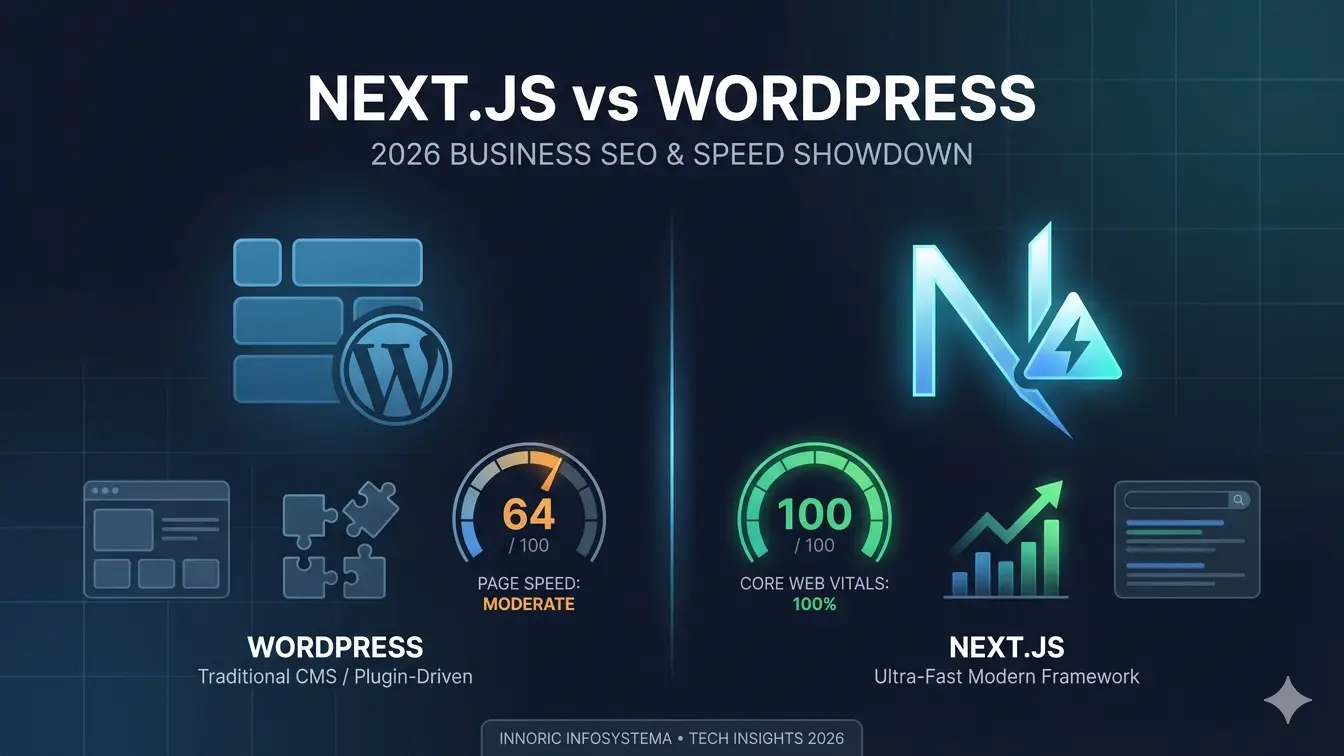
To retain clients, your business website must load quickly. Page speed, Core Web Vitals and mobile performance will be prioritised by Google’s search engine algorithms in 2026.
When building or redesigning your business website, choosing between WordPress (the most popular CMS globally), and Next.js (modern framework used to create fast loading business and E-Commerce websites) can be a difficult decision to make.
We have experience creating with both WordPress vs. Next.js. Below is our genuine comparison of these solutions for SEO, speed, security and value for money.
Quick Comparison: Next.js vs. WordPress for Business
| Feature | WordPress | Next.js |
|---|---|---|
| Page Load Speed | Moderate (slows down with heavy plugins) | Ultra-fast (static & server-rendered pages) |
| Google SEO Readiness | Good (requires SEO plugins & manual tuning) | Superior (built-in speed & clean code structure) |
| Security | Vulnerable if plugins/themes aren’t updated | Highly secure (no public database or plugin flaws) |
| Ease of Content Updates | Very easy for non-technical teams | Easy when paired with a Headless CMS |
| Upfront Development Cost | Lower to moderate | Moderate to higher (custom engineering) |
| Best For | Startups, simple blogs, budget-conscious sites | Growing companies, high-traffic brands, local market leaders |
1. Website Speed and Core Web Vitals
Core Web Vitals are used in Google SEO rankings directly.
WordPress: By default, sites built on WordPress will perform reasonably well. How
ever, for business sites, it is common to use complex page builders such as Elementor, alongside between 15-20 additional plugins to provide form functionality, SEO, and security features. Adding plugins increases the complexity of the code on your site making mobile pages slow to load.
Next.js: Next.js supports server-side rendering and static page generation,
allowing pages to be prepared before or during a user’s visit for faster content delivery. It also offers built-in image optimization, code splitting, and efficient loading of page-specific resources. These features can improve page speed, user eperience, and Core Web Vitals, potentially helping websites
achieve strong Google PageSpeed Insights scores when properly optimized.
SEO Winner – Next.js
Faster websites lead to fewer bounces, better SEO, and increased conversion rates (phone calls & enquires).
2. Search Engine Optimisation (SEO)
To perform well in local search results for ‘ near me’, clean architecture is essential.
WordPress: Uses plugins (Yoast/Rank Math) to optimise meta tags, sitemaps and schema. However, with poorly coded themes, performance may be limited compared to quicker competitors.
Next.js: Developers have full control over page metadata, clean schema, dynamic sitemaps and clean URLs. No third party plugins required. Pages are easily crawled by search engines.
SEO Winner – Next.js, if you want to perform well in competitive areas. If speed of setting up a basic blog with plugins is more important, WordPress is a good option.
3. Security and Maintenance
If your site is hacked, Google may block your domain completely.
WordPress: As WordPress is used on over 40% of the web it is the most targeted by bots. Malware can easily be introduced through outdated plugins/themes. Weekly maintenance required.
Next.js: Because Next.js separates the front-end and back-end of your site, you do not have public login pages (/wp-admin) or vulnerable third party plugins exposed to the internet. This means that Next.js sites are very secure against standard automated attacks.
Winner: Next.js.
4. Cost and Content Management
WordPress: WordPress is extremely affordable to implement. This means that if your marketing team can easily post content daily via a simple interface, without needing the help of developers, WordPress is a great option.
Next.js: Next.js is more expensive to implement, however if paired with a modern Headless CMS (such as Strapi/Sanity) within your project then you will have a simple interface for editing content (text/images). Therefore, you get the best of both worlds!
Final Verdict: Which Platform Should Your Business Choose?
If you should choose WordPress: You are starting a new business, and therefore have very limited funds. Alternatively, you may be looking to create a basic information based website quickly (within 2 weeks) or operate a content heavy blog without bespoke web features.
If you should Choose Next.js: Your website is a major lead generation tool. Or perhaps you would like to outperform your competitors on Google by having a faster loading website. Alternatively, you may be fed up with the slow, clunky plugin based websites and regular issues that occur when they are updated.
Build a faster, higher Ranking Website
Whether you need a fast, customised web application with Next.js or a high conversion focused website with WordPress, Innoric Infosystems can build digital assets to improve Google visibility and drive business growth.
Looking for a reliable web design company in Gorakhpur or a high performance digital partner to increase your online leads? Get in contact with Innoric Infosystems to get a free speed and SEO audit on your website.
FAQs
Is Next.js a better option for SEO in 2026 compared to WordPress?
In competitive markets, Next.js provides better SEO than WordPress. Due to being so quick to load, having clean code, and excellent Core Web Vitals scores, it will perform well in Google.
Can we move from WordPress to Next.js without losing our position in Google?
Yes! If moved by an experienced development team, you can move from WordPress vs. Next.js with all of your previous URLs, meta tags and backlinks in place (via correct 301 redirects). In many cases you may see an improvement in your Google ranking thanks to the faster website.
Is WordPress suitable for small businesses?
Yes! For small businesses, start-ups or local services, WordPress is very affordable to implement. It allows easy website management for businesses with less upfront costs.