




In the competitive private healthcare market, patient experience depends on two key factors: quality of care and speed of service HIS software. Patients may spend over 50 minutes waiting for registration, billing, or pharmacy services for every hour they spend with clinicians.
For multi-specialty clinics and regional hospitals, disconnected accounting systems, outdated desktop software, and paper-based records create serious challenges. These methods slow operations, increase errors, and make patient management more difficult. Administrative inefficiencies pose a significant threat to not only the staff morale but the establishment’s reputation and profitability.
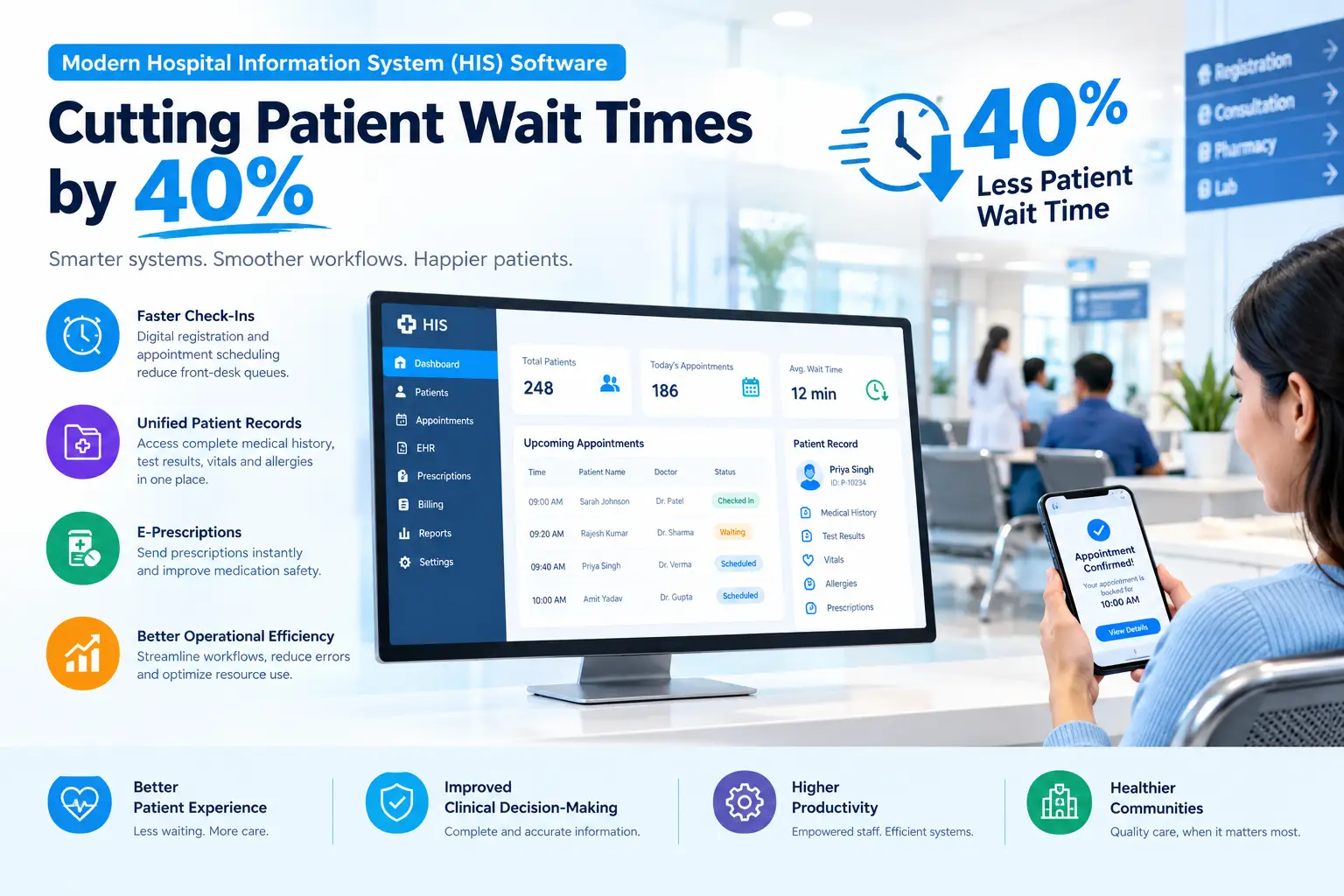
A cloud-based unified hospital information system solves these problems by consolidating the key departments within a single software ecosystem. Modern medical facilities which employ custom hospital information system software solutions report slashed administrative costs and a 40% reduction in patient wait time on average.
The Core Modules of a Unified HIS Ecosystem
Modern healthcare facilities are complex ecosystems which require seamless cooperation between interconnected departments. A standard commercial software often fails to address each unique nuance, while a custom hospital information system is engineered to unify everything under one interface:
─────────────────────────────┐
│ Central Patient Record │
└──────────────┬──────────────┘
│
┌───────────────────────┼───────────────────────┐
▼ ▼ ▼
┌─────────────────┐ ┌─────────────────┐ ┌─────────────────┐
│ OPD/IPD Portal │ │ Pharmacy/Lab │ │ Smart Billing & │
│ & Scheduling │ │ Integration │ │ Insurance Claim │
└─────────────────┘ └─────────────────┘ └─────────────────┘
• OPD/IPD & Smart Appointment Scheduling: When patients register at the hospital, it is usually the first point of interaction. Digital intake forms allow patients or front-desk staff to enter patient details, check doctor availability, and book appointments instantly. This process reduces queues and speeds up registration.
. Electronic Health Records (EHR) and E-Prescriptions: EHR systems reduce paperwork and help doctors record clinical notes digitally or upload scanned documents. A centralized patient record brings together medical history, test results, vital signs, and drug allergies. This information helps clinicians make faster, more informed decisions.
• Integrated Pharmacy & Laboratory Management: The moment a doctor schedules the tests or medication, the relevant staff (lab technician or pharmacist) can see it in the integrated system. The latter has the real-time stock information for prescriptions while the former can pick the relevant test panel.
• Automated Billing & Insurance Processing: For hospital admins, billing is one of the most headache-inducing procedures. Dividing costs for rent, consultations, consumables, insurance, and other third-party entities can be automated to a large extent using a custom HIS solution.
Three Ways Custom Software Decreases Wait Times and Boosts Revenue
1. No More Duplicate Information Entry
The same set of patient information is entered into dozens of different systems at a non-integrated hospital. In an integrated solution, the patient receives a single unique ID which can be used to find them across departments with no additional data entry steps.
2. Smart Queuing and Personnel Redistribution Based on Real-Time Data
The most up-to-date information on patient inflow is known to the nursing team and floor managers. Using the dashboard feature common to all modern HIS applications, it is possible to see which beds are occupied, what lab tests patients have scheduled, and where the waitlist is forming. If one of the lab counters has more visitors than others, redistribution of staff between stations may be necessary to provide good quality of service without overloading employees.
3. Preventing Stockouts Through Consumables Management
There is little worse for an outpatient pharmacy or hospital admin than a sudden stockout of some essential medications or consumables. Using an integrated application with an automated purchasing module helps prevent such situations by linking your inventory to it. The software will know when it is nearly out of syringes or specific drugs and will prompt the staff to replenish the stocks with certain suppliers.
Keeping Patient Data Secure and Compliant with Regulations
When it comes to patients’ health data, security and legal compliance are vital. That is why it is always better to build security into your custom HIS from the ground up instead of trying to retrofit it onto old systems later:
• RBAC Permissions Across Systems: Not everyone in the hospital needs to see the same information. Ideally, nurses and technicians only see patients’ vitals and medication lists while doctors review the test results and financial staff only sees the billing information. Receptionists, in their turn, may only be able to schedule appointments or view the patients’ information depending on the hospital’s size.
• Audit Trail for Patient Files: A way to deter would-be fraudsters is to make their intended action impossible. This is why it is always a good idea to restrict access to patient records and only allow editing functions for essential personnel. Another popular alternative is to enable an automatic audit trail procedure which will leave a paper trail every time someone views or edits the file.
Innoric Infosystems’ Role in Your Digital Transformation
A custom-built digital ecosystem for healthcare facilities requires a careful balance between quick decision-making and rock-solid data security. When it comes to building integrated hospital information system solutions, Innoric Infosystems specializes in the following:
- • Designing Applications Around Your Physical Infrastructure: We build our applications in a way that they complement the existing staff procedures instead of disrupting them.
- • Migrating Your Old Patient Data Into New Software: If you want to digitize your paper records or migrate information from another medical management solution, our experts can help you extract and structure it for import.
- • Interoperability With External Entities: We connect your internal software with external laboratory equipment, PACS/DICOM systems for imagery, and payment processors for smoother operations.
Conclusion: Make Your Hospital’s Operational Efficiency Part of Its Brand
In today’s interconnected world, the brand image of your hospital is formed by more than just the doctors and medics. The staff at the reception desk or the billing department represents the facility just as much as intensivists or surgeons. That is why investing into a custom HIS solution is so crucial for hospitals aiming to improve their public image and increase their throughput.