






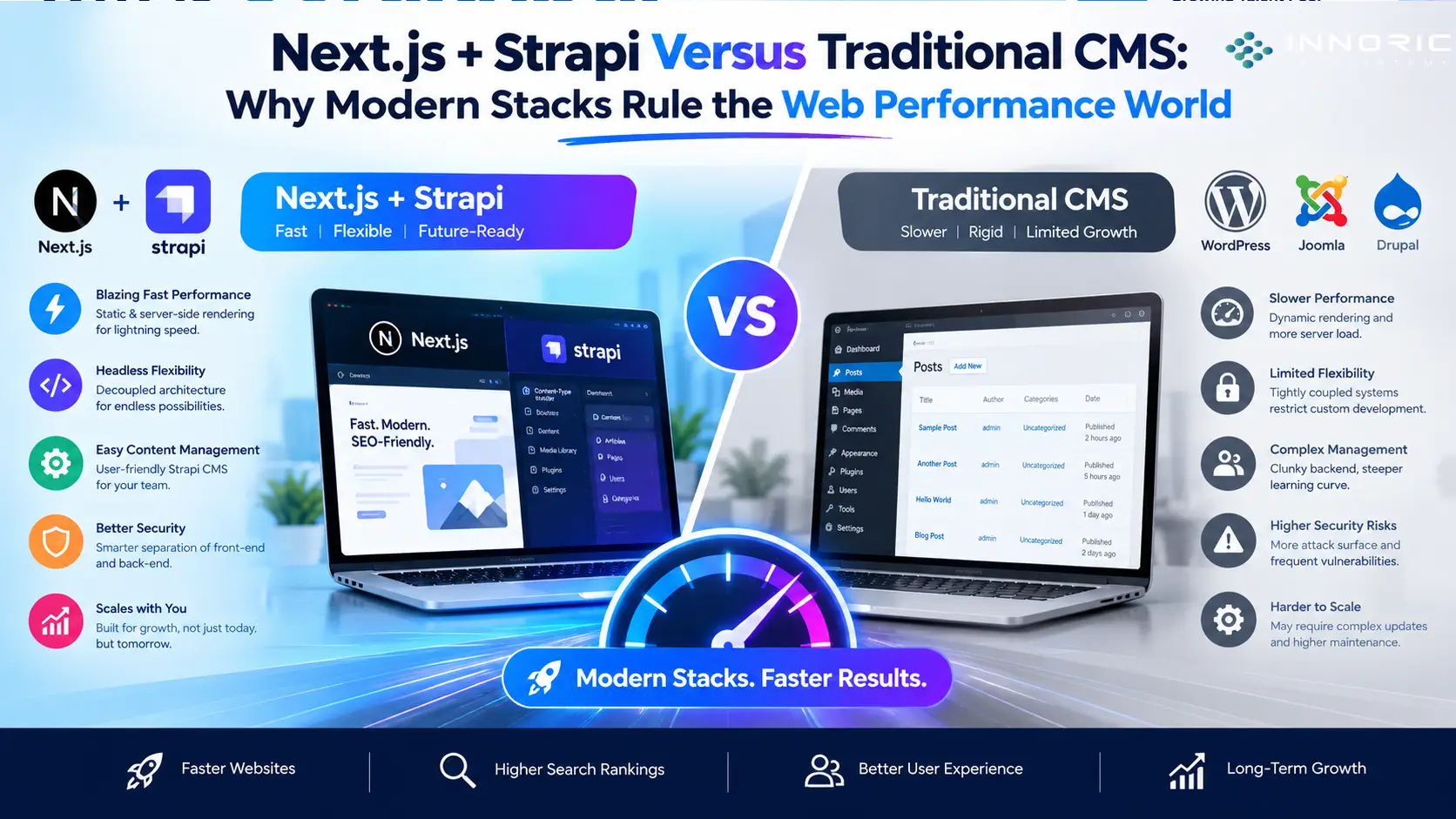
A slow corporate website is a leaking faucet of business revenue. Today, each second of mobile website loading time lost, cuts mobile conversion rate by 20%. While some time ago traditional monolithic Content Management Systems (CMS) were the industry standard for building business websites, they can no longer keep up with the demands of modern businesses and search engines.
These CMS platforms combine the frontend (what the user sees) and the backend (the database and administration panel) in one software. The result is bloated code, sluggish performance, and frequent security issues. The modern solution is to decouple the presentation layer from the CMS and utilize the latest technologies to build a business website of incredible speed and security.
The most popular stack for such projects is Next.js + Strapi. Decoupling your website with Next.js + Strapi will provide you with blazing-fast page loads, enterprise-grade security, full design freedom, and unmatched flexibility. But how exactly does it supercharge your business website? And why should you consider the change? Let’s dive in and review the key advantages of the Next.js + Strapi stack.
Understanding the Stack: What is Next.js + Strapi?
To fully leverage the benefits of the Next.js + Strapi stack, it’s important to first understand what they are and how they work together. First, a few words about the components of the stack.
Next.js (The Presentation Layer): Next.js is a React framework which reinvents the way we deliver content to website visitors. Instead of relying on the website visitor’s browser to perform complex calculations and database queries, Next.js allows you to generate pages in advance. Developers call this feature Static Site Generation (SSG) and it dramatically reduces the response time of your website.
Strapi (The Content Engine): Strapi is an open source headless CMS which can be used to store and manage your content. Unlike traditional CMS platforms, Strapi does not tie you to a specific frontend technology. Strapi only stores your content and makes it available to your frontend application via simple REST or GraphQL API. This decoupled approach is much more flexible and secure than the traditional CMS approach.
The Synergy
The stack combines a powerful frontend framework with a feature-rich content management system to provide you with best of both worlds. Your content stays securely managed in Strapi CMS and reaches website visitors through the Next.js framework. Both systems communicate through REST or GraphQL APIs while operating independently. This headless architecture gives your enterprise greater flexibility, simplifies content management, and enables your development team to build fast, scalable web experiences.
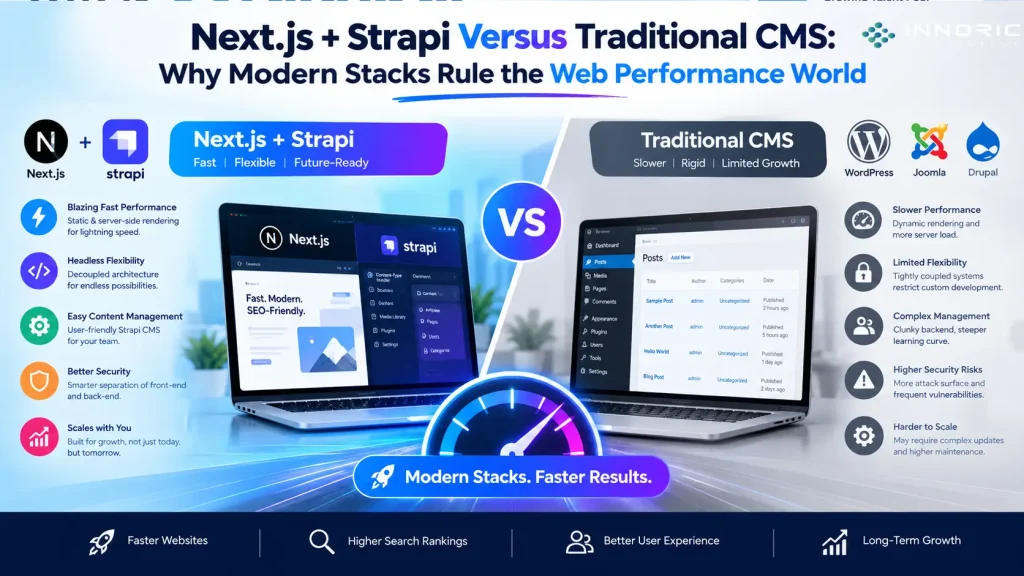
Head-to-Head Comparison: Traditional vs. Headless CMS
| Performance Metric | Traditional CMS (e.g., Monolithic WordPress) | Modern Stack (Next.js + Strapi) |
|---|---|---|
| Page Speed & Core Web Vitals | Slow Time-to-First-Byte (TTFB); heavy reliance on plugins and database calls on every single click. | Near-instantaneous load times; pre-rendered static HTML files served via global CDNs. |
| Security Risk Profile | High risk; database and administrative panels are publicly exposed, making them top targets for brute-force attacks. | Unbreakable; the backend server and database are hidden completely behind secure APIs and custom firewalls. |
| Design & UX Freedom | Locked into rigid theme templates, page builders, and plugin ecosystems that limit visual layout. | Unlimited creative freedom; developers can design bespoke, stunning UI/UX experiences tailored to your brand. |
| Infrastructure Scalability | Requires expensive server upgrades and complex caching layers to handle sudden traffic spikes. | Serverless deployment allows the static frontend to scale effortlessly to millions of hits without crashing. |
3 Core Reasons Why Enterprises Migrate to Next.js + Strapi
1. Best Core Web Vitals Score and SEO Optimization
Google’s algorithm prioritizes websites that demonstrate higher Core Web Vitals score, therefore pushing down the ones that underperform on page experience metrics.
While monolithic CMSs attempt to deliver a dynamic web page every time a user reloads it, requiring database queries, theme parsing and a dozen of plugins execution, Next.js prerenders your web pages as static HTML documents. Such documents are then distributed via CDN to make sure their loading speed is optimal for users. This way, your pages will consistently score 100/100 on Core Web Vitals thus improving SEO performance.
2. Higher Security Level Across All Stacks
In a traditional CMS-based website, the same server hosts the database with users’ information, core application programming logic, and a public website area. A hacker only needs to find a vulnerability in one particular stack to gain unauthorized access to the others.
Next.js application does not contain any database and user management logic, making it significantly safer.
If your enterprise separates the front end from the back end, you can deploy the Strapi API on a dedicated server and restrict access to authorized applications, including your Next.js website. By securing the Strapi dashboard, enforcing proper authentication, and limiting API permissions, you can reduce the risk of unauthorized access and protect sensitive data.
3. Native Multi-Channel Content Distribution
The modern enterprise needs to build a presence across numerous channels, from a mobile website and a native application to a customer portal and billboards. In a traditional CMS-based setup, the content management system would need to be modified to work with all these channels, requiring complex API layers for each.
However, Strapi CMS is inherently multi-channel as it only stores data as entries. This way, a single piece of content created in Strapi can be effortlessly synchronized across all available channels.
The Innoric Infosystems Take on Web Platform Migration
Enterprises that want to migrate their web platform to a faster, more secure and SEO-friendly technology require a reliable technical partner that understands the challenges of such project. At Innoric Infosystems, we specialize in building enterprise-class digital experiences that perform well and scale with the business.
Here is how we bring our expertise to bear on a Next.js migration project:
• SEO-Friendly Redesign: When you migrate your existing CMS content to Next.js, make sure you redirect every relevant URL and restructure your website assets correctly to preserve SEO value.
We build technically sound, SEO-friendly URL structures that help protect your search rankings throughout the migration.
• Custom Front-end Development: Most traditional CMSs use a set of default themes and templates for website building. We do not believe in cookie-cutter solutions and always strive to build a custom front-end architecture that would match your enterprise image.
. Marketing-Friendly CMS: Many content management systems feel too technical and difficult to use. When we migrate your enterprise website to Strapi, we customize the backend to give your marketing team an intuitive interface for managing content, updating pages, and publishing campaigns with ease.
Conclusion: Decouple Your Web Platform for Higher Performance
Decoupling CMS and front-end technologies makes a website faster, more secure and easier to maintain. While enterprise-class organizations are the first to adopt such solutions, smaller businesses may find that migrating from a traditional CMS to a next.js + Strapi stack is a wise decision. To learn more about the benefits of a decoupled web platform, contact the enterprise web development experts at Innoric Infosystems.