






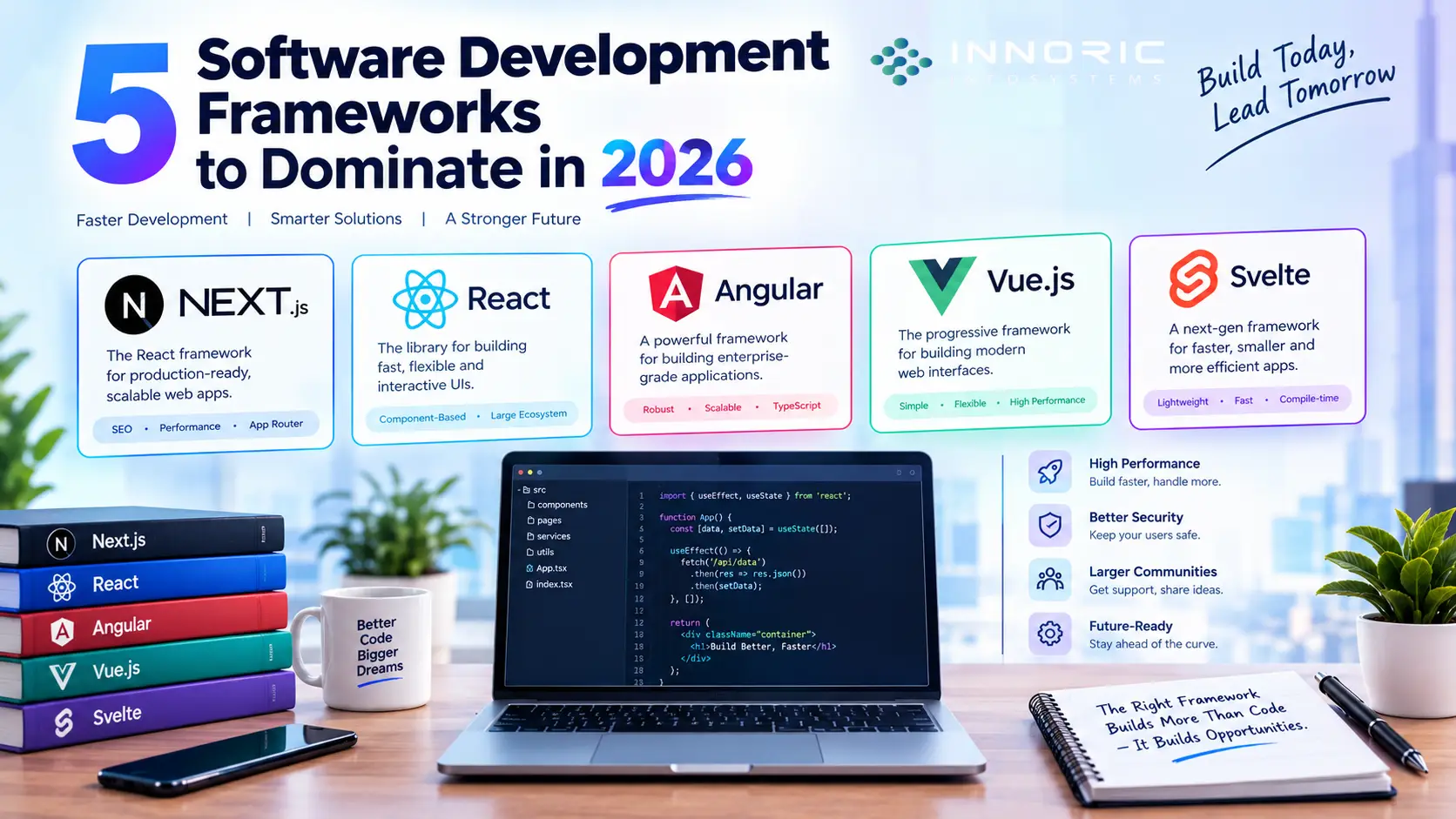
The world of software development is constantly evolving, and technologies previously thought to be cutting-edge are quickly overtaken by new tools which better leverage edge rendering, AI-native architecture, and developer velocity.
As we enter 2026, to build scalable web and mobile applications in a way that can process the heft data without compromising end-user experience, these are the top 5 software development frameworks in the industry for both enterprise architects and developers.
1. Next.js 16 (The React Powerhouse)
Next.js continues to reign supreme as the most popular production framework for React based applications. With the release of Next.js 16, it has managed to cement its status as the leading-edge tool for React developers who want to take advantage of the latest hybrid rendering capabilities in React Server Components (RSC).
Why is it popular? It has native support for partial pre-rendering (PPR) and offers a superior balance between static and dynamic rendering. This means developers can deliver static shell elements while simultaneously fetching dynamic data without any lag.
Best for: Building high-traffic e-commerce platforms, enterprise dashboards, and SEO-focused content hubs with React.
2. SvelteKit (The Zero-Overhead Challenger)
With the dominance of virtual DOM frameworks, SvelteKit has emerged as a serious challenger to the status quo which holds that React, Angular, or Vue are the only viable ways to build performant applications.
Why is it popular? Unlike other front-end frameworks which run in the browser, SvelteKit compiles applications down to ultra-efficient vanilla JS at build-time. This eliminates the overhead of the virtual DOM and makes these applications incredibly fast. SvelteKit applications bundle smaller than their React counterparts by a significant margin, which is critical for mobile-first applications.
Best for: Building resource constrained progressive web apps (PWAs), data-heavy interactive visuals, and applications where every byte in the bundle matters.
3. Flutter (The Cross-Platform Standard)
Google’s Flutter has firmly established itself as the number one cross-platform mobile development framework, and in 2026 it has broken through the ceiling of just being a “mobile framework” to also target the Web and Desktop with a single codebase.
Why is it popular? Maintainers have worked tirelessly to bring Flutter to new platforms and environments, but the ability to write less code for multiple apps (iOS, Android, Web, Desktop) with fewer bugs dominates the conversation. With newer rendering backends like Impeller, animations at 120fps in Flutter are a breeze on all devices, reducing the cost and time of development.
Best for: Building enterprise cross-platform applications, minimum viable products (MVPs), and consumer apps with custom UIs.
4. Spring Boot 3.x / 4.0 (The Enterprise Backbone)
When it comes to building secure, enterprise-grade applications, Java’s Spring Boot dominates the conversation with unparalleled performance. In 2026, Spring Boot has taken full advantage of GraalVM Native Images to optimize startup time and memory footprint of Java applications.
Why is it popular? The entire ecosystem now works with GraalVM Native Images which reduces application memory consumption by up to an order of magnitude while reducing startup time to a fraction of traditional Java apps. This has critical implications for enterprise app development since cloud costs scale with memory consumed by applications.
Best for: Building FinTech platforms, healthcare systems, large-scale microservices, and reliable cloud-native applications.
5. Actix Web (The High-Performance Speed Demon)
As enterprises look to reduce cloud bills through optimizations at the application layer, Rust has emerged as a serious candidate to build high-performance backends in a systems programming language. Actix Web is the most popular Rust web framework which focuses on building fast HTTP services with low latency.
Why is it popular? Actix Web is one of the fastest Rust web frameworks out there, and it consistently scores in the top 1-2% in independent performance benchmarks. These applications are able to handle millions of requests with lower CPU overhead, enabling critical real-world applications like APIs for high-performance trading or IoT data pipelines in real-time.
Best for: Building high-performance low-latency applications like APIs for high-performance trading systems or IoT data pipelines in real-time.
Summary: How to Choose Your Stack in 2026
| If your primary goal is… | The Framework to choose is… |
|---|---|
| Rapid frontend scaling & SEO superiority | Next.js |
| Maximized client-side performance & tiny footprints | SvelteKit |
| Simultaneous iOS, Android, and Web deployment | Flutter |
| Bulletproof enterprise architecture & security | Spring Boot |
| Blazing fast backend speed & cloud cost reduction | Actix Web |
Conclusion
The choice of a framework in 2026 will be guided not by individual preferences but rather by architectural considerations. Startups that want to scale exponentially are embarking on the Next.js and Flutter-based development trail. In contrast, scale-ups that seek to reduce their cloud expenditure are adopting SvelteKit and Actix Web.
Tying business goals to a framework’s underlying performance characteristics is the key to building digital products fit for purpose this year.